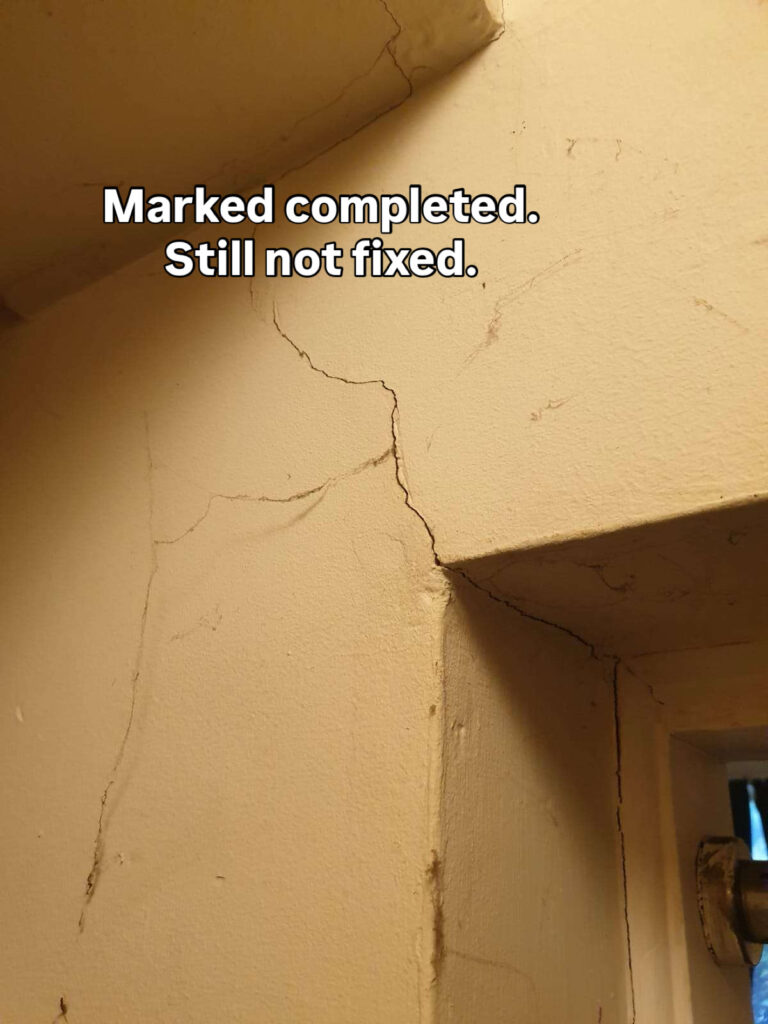
It is frustrating to report a repair, wait for an appointment and then discover that the job has been marked as completed even though nobody attended or the problem is still there.
This happens more often than many tenants realise. A repair may be closed because a contractor recorded the wrong outcome, an appointment was missed, only part of the work was completed or the landlord’s system was updated incorrectly.
Whatever the reason, a closed repair record does not make the underlying problem disappear.
Here are the practical steps you should take if your landlord says a repair has been completed but your home has not actually been fixed.
1. Check the repair status carefully
Start by checking exactly what your landlord’s system says.
Look at:
- Your online tenant portal
- Emails or text messages
- Repair reference numbers
- Appointment confirmations
- Any message stating that the work was completed
Take screenshots before the information changes.
Make a note of the date the repair was first reported, the date it was marked as completed and whether anybody attended the property.
This creates a clear timeline and helps prevent disagreements later about what was reported and when.
2. Take new photographs or videos
Photograph or film the problem again after the repair has been marked as completed.
Try to capture:
- The full affected area
- Close-up images of the damage
- Any water staining, mould, cracks or deterioration
- The date, where possible
- Damage to furniture, flooring or personal belongings
Do not rely only on photographs taken months ago. New evidence helps show that the issue remained unresolved after the landlord claimed the work had been completed.
Keep the original files rather than only sending screenshots through social media or messaging apps.
3. Report the repair again in writing
Contact the landlord and clearly explain that the repair has been closed incorrectly.
Email, an online portal or another written method is preferable because it creates a record.
You could write:
The repair reported under reference [reference number] has been marked as completed, but the problem has not been fixed. Please reopen the repair and confirm when somebody will attend. The issue remains ongoing, and I have attached current photographs showing its condition.
Include:
- Your address
- The original repair reference
- The date the problem was first reported
- A short description of what remains unresolved
- Photographs or videos
- Any effect on your household
Ask for a new repair reference and an expected appointment date.
Landlords are generally responsible for important parts of a rented home, including its structure and exterior, heating, hot water, sanitation, pipes, drains and electrical wiring. Tenants should report faults promptly, particularly where they may affect health or safety.
4. Explain whether the problem is getting worse
Do not simply say, “It has not been fixed.”
Explain what is happening now.
For example:
- The leak is spreading
- The ceiling is becoming unstable
- The mould is returning
- The heating still does not work
- Water is affecting electrical fittings
- A child, older person or disabled tenant is affected
- The problem is damaging belongings
- A room cannot be used safely
This helps the landlord understand the urgency and provides evidence of the impact of the delay.
Serious hazards involving electricity, structural safety, heating, water or health should be reported immediately.
5. Keep a repair diary
A simple repair diary can become extremely valuable if the problem continues.
Record:
- Every date you contact the landlord
- The method used
- Who you spoke to
- Repair reference numbers
- Appointments offered
- Missed visits
- Contractor names
- What work was attempted
- Whether the problem returned
- How the issue affected your household
Keep copies of emails, portal messages, letters and text messages.
Avoid relying only on telephone conversations. After a call, send a brief email confirming what was discussed.
For example:
Further to our telephone call today, I understand that the repair will be reopened and an appointment will be arranged. Please confirm this in writing.
6. Make a formal complaint
If the repair is repeatedly closed, ignored or left unresolved, use your landlord’s formal complaints procedure.
Make it clear that you are raising a formal complaint, rather than simply reporting the repair again.
Include:
- The repair history
- Relevant reference numbers
- Dates of missed appointments
- Evidence that the job was marked as completed
- Photographs showing that it remains unresolved
- The effect on you and your household
- What you want the landlord to do
You may ask for:
- The repair to be reopened
- A proper inspection
- A confirmed appointment
- An explanation of why it was closed
- Reimbursement for reasonable losses, where appropriate
- Consideration of compensation through the complaints process
Council and housing association tenants in England may be able to approach the Housing Ombudsman after completing the landlord’s complaints process, or where the landlord is failing to respond. The Ombudsman can consider complaints involving property condition, repairs and complaint handling.
Complaint and escalation routes differ depending on whether you live in England or Wales and whether your landlord is a council, housing association or private landlord.
7. Do not stop paying your rent
Even when repairs are outstanding, tenants should normally continue paying their rent.
Withholding rent without proper legal advice can create rent arrears and put the tenancy at risk. Government guidance advises tenants to keep paying rent while waiting for repairs.
Keep the repair dispute separate from your rent payments unless a qualified adviser tells you otherwise.
8. Contact the council if the conditions may be unsafe
If you rent privately and the problem may create a serious health or safety risk, you may be able to contact the environmental health or housing standards team at your local council.
The council may inspect the property and assess hazards.
Government guidance states that tenants can contact the local authority where repairs are not completed and the conditions may cause harm or nuisance.
Council and housing association tenants should usually follow their landlord’s repairs and complaints procedures, although additional routes may be available depending on the circumstances.
9. Seek advice if the repair remains unresolved
Consider seeking advice if:
- The problem has continued for months
- You have reported it repeatedly
- The repair has been closed more than once
- Contractors attend but do not complete the work
- The condition is affecting your health
- Your belongings have been damaged
- Rooms cannot be used safely
- Your landlord is not responding to complaints
A housing adviser or legal professional can review the repair history, your tenancy and the evidence you have collected.
Can you make a housing disrepair claim?
Some tenants may be able to pursue a housing disrepair claim where a landlord responsible for repairs has been notified of an ongoing problem and has failed to deal with it within a reasonable period.
Whether a claim is appropriate depends on factors including:
- Your type of tenancy
- How long you have lived at the property
- The nature and severity of the problem
- How often it was reported
- How long the landlord has known about it
- Whether the issue remains ongoing
- The evidence available
- The effect on your household
Compensation and outcomes vary, and not every unresolved repair will result in a claim.
Need help with an unresolved repair?
Housing Disrepair Advice provides initial guidance to eligible council and housing association tenants across England and Wales.
You may be suitable for an assessment if:
- You have a proper tenancy
- You have lived in the property for at least 12 months
- The repair problem is still ongoing
- You have reported it to your landlord
- Your landlord has had a reasonable opportunity to deal with it
Temporary accommodation residents and tenants whose repairs have already been fully resolved may not meet our commercial intake criteria.
Website: www.housing-disrepair-advice.org
WhatsApp: https://wa.me/message/JEXHTTVFFR7CD1
Telephone: 0203 824 2452
This article provides general information and is not a substitute for legal advice. Eligibility for assistance or a claim depends on the individual circumstances.