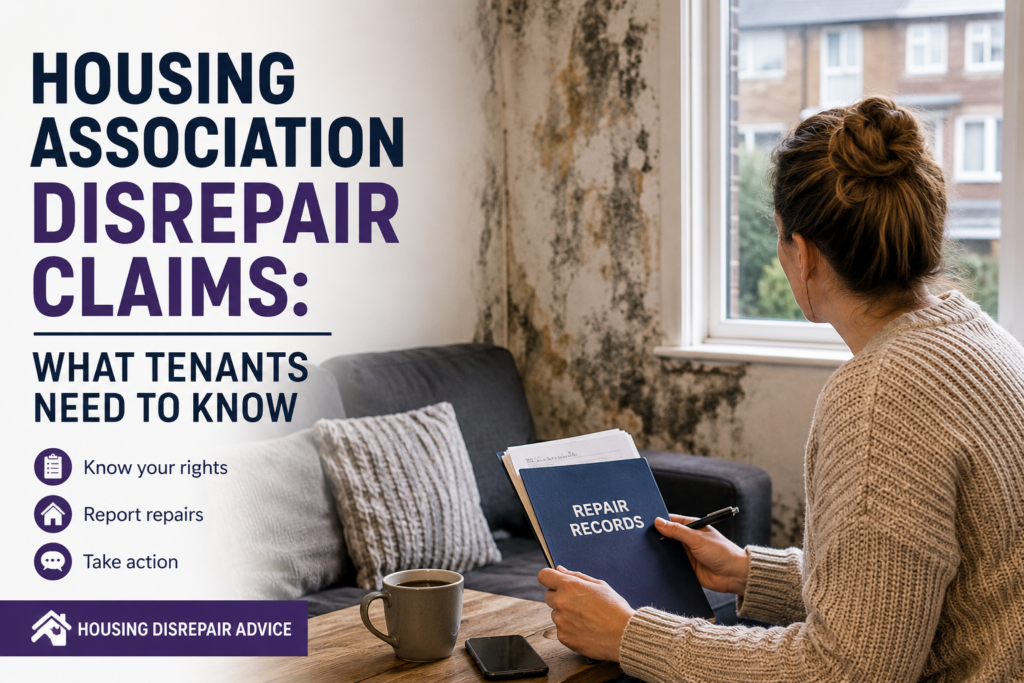
If you rent your home from a housing association and serious repair problems are being left unresolved, you may be wondering whether you can make a housing association disrepair claim.
Housing associations have responsibilities to keep the homes they rent safe and in an appropriate state of repair. Reporting a problem does not automatically mean you have a compensation claim, but if your housing association knows about disrepair and fails to deal with it properly, you may have options to escalate the problem and seek further advice.
This guide explains what housing association disrepair can include, what evidence tenants should keep, how the complaints process works and when unresolved repairs could potentially lead to a housing disrepair claim.
What is housing association disrepair?
Housing disrepair generally refers to defects or poor conditions that your landlord is responsible for repairing.
Common examples include:
- Damp and mould caused by defects in the property
- Leaking roofs, pipes or windows
- Broken boilers or heating systems
- Persistent loss of hot water
- Unsafe or defective electrics
- Structural cracks
- Damaged plaster caused by leaks
- Rotten or defective windows and external doors
- Drainage and sanitation problems
- Defects affecting communal areas for which the housing association is responsible
- Pest problems linked to defects in the building
Not every maintenance problem will automatically amount to actionable housing disrepair. The cause of the problem, who is responsible for repairing it, how long the landlord has known about it and what action it has taken can all be important.
What are housing associations responsible for?
Housing associations are landlords and cannot simply ignore their repairing responsibilities because they are social housing providers.
In England, landlords are generally responsible for important parts of the property including its structure and exterior and installations supplying water, gas, electricity, sanitation, heating and hot water. The Homes (Fitness for Human Habitation) Act 2018 also gives qualifying tenants rights where rented accommodation is not fit to live in and applies to both the private and social rented sectors.
Housing law in Wales is different. Under the Renting Homes (Wales) Act 2016, landlords have duties to keep qualifying homes fit for human habitation and to keep the structure, exterior and essential service installations in repair. Once a Welsh landlord becomes aware that repairs are required, they must generally carry them out within a reasonable time and to a reasonable standard.
This means housing association tenants in both England and Wales have legal protection, although the legislation and claims procedures are not identical.
Step 1: Report the repair to your housing association
The first step is to make sure your housing association knows about the problem.
Report repairs through its official reporting system whenever possible. This might be through a telephone repairs line, online tenant portal, app, email or housing officer.
Ask for a repair reference number.
If you report something by telephone, record the date of the call and what you were told. Where possible, follow the conversation with an email so there is written evidence.
Be specific.
Instead of simply saying that you have “damp”, explain which rooms are affected, whether mould is present, whether the condition is spreading and whether furniture, clothing or other belongings have been damaged.
If the problem is potentially dangerous, make that clear.
A landlord cannot properly assess the urgency of a repair if it has not been told how serious the situation has become.
Step 2: Start creating your own evidence file
Do not rely entirely on your housing association’s repair records.
Keep your own evidence from the beginning.
Photograph the defects clearly and take further photographs if conditions deteriorate.
Videos can be particularly useful for problems such as active leaks, water entering a property, defective heating systems, faulty windows or recurring damp.
Keep repair reference numbers, letters, emails, text messages and screenshots from tenant portals.
Record contractor visits and missed appointments.
If somebody inspects your property, note what they told you.
If you are repeatedly promised that somebody will return but nobody does, record each occasion.
A simple repair diary containing dates and events can turn months of confusing telephone calls into a clear timeline.
How long does a housing association have to make repairs?
There is not one universal deadline covering every ordinary repair.
The appropriate timescale will depend on how serious the problem is.
A minor defect may reasonably take longer to deal with than a major leak, dangerous electrical fault or heating failure during cold weather.
In England, the general legal position has traditionally involved landlords acting within a reasonable time after becoming aware of problems for which they are responsible. What is reasonable depends on the individual circumstances.
However, some social housing hazards in England now have much stricter deadlines because of Awaab’s Law.
Does Awaab’s Law apply to housing associations?
Yes. Awaab’s Law applies to social landlords in England, which includes housing associations.
As of August 2026, the first phase is already in force.
Emergency hazards must be investigated and made safe within 24 hours. Significant damp and mould hazards must generally be investigated within 10 working days and made safe within five working days after the investigation finishes.
The landlord must also normally provide a written summary of its findings within three working days following the investigation. If the home cannot be made safe within the required period, suitable alternative accommodation may have to be provided.
Importantly, Awaab’s Law does not currently place those significant-hazard deadlines on every type of ordinary housing repair.
Phase 2 is due to take effect on 30 November 2026, extending the significant-hazard rules to additional risks including excess cold and heat, falls, structural collapse, fire, electrical hazards and certain hygiene hazards.
Awaab’s Law currently applies in England. Housing association tenants in Wales have separate protection under Welsh housing legislation.
Step 3: Report failed repairs again
A contractor attending your property does not necessarily mean the repair has been resolved.
If somebody paints over mould and the mould returns, report it again.
If a roof is patched but continues leaking, report it again.
If plaster is replaced without fixing the leak that damaged it, report it again.
If your housing association marks the repair as completed while the problem remains, challenge the closure in writing.
This is important because a record showing repeated unsuccessful attempts at repair can help demonstrate the history of the problem.
Temporary works can sometimes be appropriate while permanent repairs are arranged. But repeatedly carrying out superficial work without addressing the cause of an ongoing defect is a different matter.
Step 4: Make a formal complaint
A repair request and a formal complaint are not the same thing.
A repair request tells your landlord something needs fixing.
A complaint tells the housing association that you are dissatisfied with the way it has handled the problem.
If repairs have repeatedly been delayed, appointments missed, problems incorrectly closed or communication has broken down, consider using the landlord’s formal complaints procedure.
For housing associations in England, the Housing Ombudsman’s Complaint Handling Code requires landlords to operate a two-stage complaint process. Stage 1 complaints should be acknowledged within five working days and normally receive a written response within 10 working days after acknowledgement. Stage 2 escalation requests should also be acknowledged within five working days, with a written response normally due within 20 working days after acknowledgement.
A formal complaint should clearly explain when you originally reported the repairs, what remains unresolved, what action has already been attempted and how the conditions are affecting you or your household.
Do not simply write, “You haven’t fixed my house.”
Give them a clear chronology.
What if the housing association still does nothing?
In England, once the housing association’s two-stage complaints process has been completed, unresolved complaints can potentially be taken to the Housing Ombudsman.
The Housing Ombudsman can investigate complaints about matters including property condition, repairs and complaint handling. It can also assist where a landlord is failing to respond properly to a formal complaint.
The Ombudsman route and a housing disrepair legal claim are not necessarily the same thing.
An Ombudsman investigation focuses on whether the housing association has provided an appropriate service and properly handled the tenant’s complaint. A legal housing conditions claim can deal with breaches of repairing obligations and may seek works, compensation or other remedies.
In some circumstances, the two issues may overlap.
What if your housing association is in Wales?
Housing association tenants in Wales should normally report the repair to the landlord and use its formal complaints procedure if the problem remains unresolved.
If the complaint is still not resolved, the Public Services Ombudsman for Wales can consider complaints about housing associations, including failures or delays in carrying out repairs and repeated missed repair appointments.
The underlying legal framework is different from England, so Welsh tenants should not rely on English legislation or the English Pre-Action Protocol when considering court action.
When can unresolved repairs become a housing disrepair claim?
There is no simple rule that says a tenant automatically has a claim after a particular number of days.
Several factors need to be considered.
Was the housing association responsible for the defect?
Did it know about the problem?
How long has it known?
Was it given a reasonable opportunity to investigate and carry out the necessary work?
Is the problem still ongoing?
How serious is it?
Has the tenant kept evidence?
Have previous attempts at repair failed?
What impact have the conditions had on the tenant and their use of the home?
Two tenants could have apparently similar problems but very different cases depending on the answers to those questions.
This is why proper assessment matters.
What happens in a housing association disrepair claim?
In England, housing conditions claims are generally dealt with under the Pre-Action Protocol for Housing Conditions Claims before court proceedings are started.
The Protocol is designed to encourage landlords and tenants to exchange information early, identify necessary repair work, resolve disputes where possible and ensure appropriate compensation is considered without unnecessary litigation.
It applies to residential properties in England and specifically covers claims arising from poor housing conditions where the landlord is already aware of the problems but they remain unresolved.
Depending on the circumstances, information may be requested about the repair history and an inspection by an appropriate expert may be required.
The goal should not simply be obtaining compensation while leaving the tenant living with the same defective property.
Getting necessary repairs completed can be an important part of the process.
How much compensation could a tenant receive?
There is no legitimate universal housing disrepair compensation calculator that can accurately tell every tenant what their claim is worth.
Compensation depends on the individual circumstances.
Relevant factors can include the type and seriousness of the disrepair, how long the tenant lived with the problem, which rooms were affected, the degree to which the property could be used normally and any identifiable losses resulting from the conditions.
Damage to belongings may also be relevant in appropriate circumstances where the evidence supports it.
The existence of mould, a leak or a broken boiler does not automatically create a fixed compensation payment.
Any website promising an exact amount before properly understanding the circumstances should be treated cautiously.
Do you need photographs to make a claim?
Photographs are extremely useful, but not having perfect photographic evidence from day one does not necessarily mean you should abandon the issue.
Other evidence can include repair records, emails, complaint responses, text messages, contractor visits, inspection reports and the housing association’s own records.
Start collecting evidence now rather than worrying about what you did not photograph several months ago.
If the problem is still present, record its current condition.
Can you claim if the housing association has now repaired the problem?
Potentially, depending on the circumstances.
Completing repairs does not necessarily erase what happened before they were completed.
If a landlord was responsible for serious disrepair and unreasonably failed to resolve it for a substantial period, the history may still be relevant even if repairs have now been carried out.
However, whether there is a viable claim will depend on the facts and evidence.
Should you stop paying your rent?
Do not assume unresolved repairs automatically mean you can stop paying rent.
Withholding rent can create arrears and potentially lead to a separate tenancy problem.
The position can be particularly complex in Wales because of the wording of occupation contracts and fitness-for-human-habitation provisions. Welsh Government guidance specifically recommends obtaining advice before deciding to withhold rent because a landlord or court may disagree that the legal threshold has been met.
Seek appropriate advice before taking action that could affect your tenancy.
Being a housing association tenant does not mean you have to accept unresolved disrepair
Social housing tenants sometimes assume there is little they can do because their landlord is a large housing association.
That is not the case.
Housing associations have repairing responsibilities. They have formal complaints procedures. Tenants in England have access to the Housing Ombudsman and protections including Awaab’s Law. Welsh housing association tenants have rights under the Renting Homes (Wales) Act and access to the Public Services Ombudsman for Wales.
The important thing is to create a record.
Report the problem.
Keep evidence.
Record what happens.
Escalate matters when appropriate.
And if significant problems remain unresolved after your housing association has been given the opportunity to deal with them, consider getting advice about whether further action may be available.
Need help with housing association disrepair?
If you are a housing association tenant dealing with unresolved repairs, Housing Disrepair Advice can help you understand what options may be available.
We can look at the problems affecting your property, when they were first reported, what your housing association has done and whether the defects remain ongoing.
Where the circumstances appear appropriate, the next step can then be considered.
You do not need to wait until your home becomes dramatically worse before keeping evidence or asking questions.
If something is wrong with your property, report it.
If it is not being properly dealt with, keep a record.
And if the problem continues, do not assume being ignored means you have run out of options.
This article provides general information and does not constitute individual legal advice. Housing law and claims procedures differ between England and Wales, and the appropriate course of action will depend on the circumstances of each case.