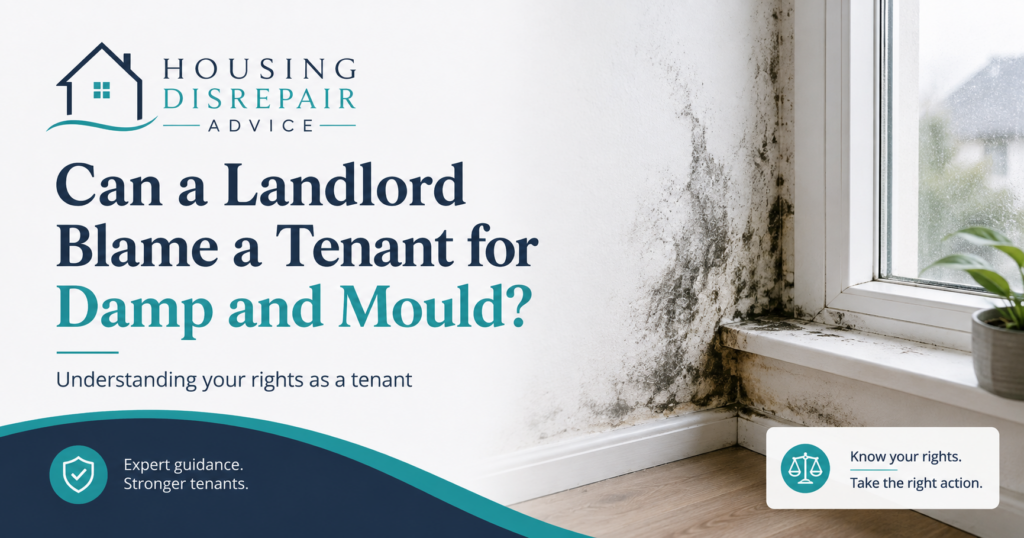
Can a Landlord Blame a Tenant for Damp and Mould?
If your landlord has told you that damp and mould are your fault because you cook, shower, dry clothes indoors or do not open the windows enough, you are far from the only tenant to hear that explanation.
Sometimes condensation and ventilation do contribute to damp. But that does not mean a landlord can simply blame the tenant and close the repair.
The underlying cause still needs to be properly investigated.
Government guidance is clear that landlords should not make assumptions about a tenant’s “lifestyle” and use that as a reason to avoid investigating damp and mould. Everyday activities such as cooking, bathing, washing and drying clothes naturally create moisture inside a home.
So what should happen if your landlord says the damp is your fault?
Can damp and mould ever be caused by the tenant?
Yes, in some situations the way a property is being used can contribute to condensation.
For example:
- Blocking ventilation
- Covering extractor fans
- Failing to use working ventilation
- Deliberately damaging the property
- Making unauthorised alterations that affect ventilation
However, that is very different from simply living normally in the property.
Cooking meals, showering, washing clothes and drying laundry all produce moisture. Government guidance specifically recognises that these are normal household activities and should not simply be treated as proof that the tenant caused the problem.
A landlord should investigate whether there is another underlying cause.
That may include:
- Leaking pipes
- Roof defects
- Penetrating damp
- Poor insulation
- Defective windows
- Broken extractor fans
- Inadequate ventilation
- Cold bridging
- Structural defects
- Previous repairs that have failed
Simply wiping away mould or telling the tenant to open a window does not necessarily deal with the underlying issue.
What should your landlord do when you report damp and mould?
Your landlord should take the report seriously and investigate what is causing the problem.
The investigation may involve checking:
- Where the mould is appearing
- Whether there are visible leaks
- Whether the walls are unusually cold
- Whether ventilation is working
- Whether extractor fans are effective
- Whether insulation is missing or defective
- Whether rainwater is entering the building
- Whether neighbouring properties are contributing to the problem
If you are dealing with another unresolved repair as well, you may find our guide on how long a landlord should take to carry out repairs useful.
The important point is that the landlord should identify the cause rather than simply assuming it.
What if the landlord keeps saying it is condensation?
Condensation is real, but the word itself does not answer the question of why excessive moisture is building up in the property.
A well-maintained home should normally have suitable heating, insulation and ventilation to help control ordinary household moisture.
If mould repeatedly returns despite cleaning, or appears across several rooms, around windows, behind furniture or on cold external walls, it may indicate that the property needs a more detailed inspection.
If work has already been carried out but the problem remains, keep fresh evidence.
Our guide on what to do if your landlord marks a repair as completed but nothing has actually been fixed explains how to document an unresolved repair and get it reopened.
What does Awaab’s Law say about blaming tenants?
For social housing tenants in England, Awaab’s Law is particularly relevant.
The first phase came into force on 27 October 2025. It requires social landlords to deal with emergency hazards and significant damp and mould hazards within fixed timescales.
Government guidance for social landlords specifically states that it is unacceptable to assume that damp and mould are caused by a tenant’s “lifestyle” and then fail to investigate the hazard.
For significant damp and mould hazards, the current rules require social landlords in England to investigate within 10 working days, provide a written summary after the investigation and make the property safe within the required period. Emergency hazards must be investigated and made safe within 24 hours.
You can read the official Awaab’s Law guidance for social housing tenants on GOV.UK.
Awaab’s Law currently applies to the social rented sector in England. The position for private tenants is different, although private landlords still have wider repair and fitness obligations.
What about private tenants?
Private landlords should also take damp and mould reports seriously.
Government guidance on damp and mould applies to both social and private rented housing providers and emphasises the need to identify and address the underlying cause.
Private tenants may be dealing with:
- A landlord directly
- A letting agent
- A managing agent
- An HMO manager
Whichever arrangement applies, keep evidence showing who was notified, when they were notified and what response you received.
If the landlord or agent keeps blaming you without carrying out a meaningful inspection, ask for the issue to be investigated in writing.
What evidence should you keep?
Evidence is particularly important where there is disagreement about the cause of damp and mould.
Try to keep:
- Photographs and videos
- Dates showing when the mould appeared
- Repair reference numbers
- Emails and text messages
- Screenshots from repair portals
- Details of inspections
- Contractor reports
- Copies of complaints
- Evidence of failed repairs
- A record of damaged belongings
- Notes about how the problem affects your household
Photograph the same areas over time where possible.
This can help show whether the mould is spreading, returning after treatment or becoming worse.
If children live in the property, you may also want to read our guide on 7 housing hazards that could put children at risk.
What should you write to your landlord?
Keep it simple and factual.
You could write:
I am reporting ongoing damp and mould at my property. I have previously been told that the issue is caused by condensation, but the mould continues to return. Please arrange a proper inspection to identify the underlying cause and confirm what action will be taken.
Include:
- Your address
- The rooms affected
- When the problem began
- Previous repair references
- Photographs or videos
- Whether the issue is worsening
- Any health or safety concerns
Ask for the response in writing.
What if the landlord refuses to investigate?
If the landlord continues to dismiss the problem, consider making a formal complaint.
Explain:
- When the damp and mould was first reported
- How often you have chased it
- What explanation the landlord has given
- Whether anyone has inspected
- What work has been attempted
- Whether the mould has returned
- How the problem is affecting the household
For council and housing association tenants, the complaints process may eventually involve the Housing Ombudsman.
Private tenants may have different escalation routes depending on the landlord, letting agent and local authority.
Can damp and mould affect health?
Yes.
Government guidance explains that damp and mould can increase exposure to allergens, irritants, mould spores and other substances that may affect health. Certain groups, including children, older people and people with existing health conditions, may be more vulnerable.
If somebody in the household is experiencing serious symptoms, seek appropriate medical advice and make sure the landlord knows that health concerns have been reported.
Do not accept “lifestyle” as the end of the conversation
Tenants still have responsibilities, and there are situations where tenant behaviour may contribute to a problem.
But a landlord should not simply blame cooking, bathing, washing or drying clothes and use that as a reason to ignore recurring damp and mould.
The issue should be investigated properly.
Keep evidence, report the problem in writing and ask the landlord or letting agent to identify the underlying cause.
If serious disrepair remains unresolved after being reported, Housing Disrepair Advice can provide free initial help, guidance and support to council, housing association and private tenants across England and Wales.
Website: https://housing-disrepair-advice.org/
WhatsApp: https://wa.me/message/JEXHTTVFFR7CD1
Telephone: 0203 824 2452
This article provides general information and should not be treated as individual legal advice. Repair responsibilities and legal options depend on the circumstances of each case.