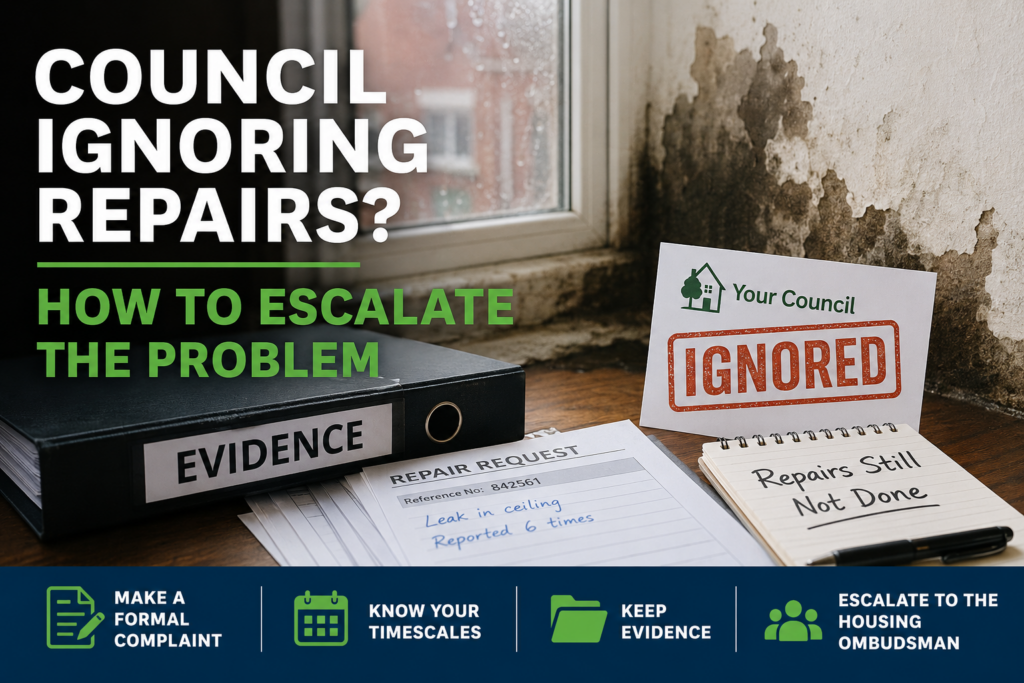
If you are a council tenant and you have reported a repair repeatedly but nothing seems to happen, it can feel as though you are going around in circles.
You report the leak. You receive a repair reference. Someone promises an appointment. The appointment is cancelled, a contractor attends but does not complete the work, or the repair is simply closed on the system.
Weeks or months later, the original problem is still there.
Council landlords have responsibilities for the condition of the homes they rent out. When a repair has been reported and the landlord fails to deal with it properly, tenants do not simply have to keep starting again from the beginning.
There are ways to escalate the problem.
This guide explains what to do when your council is ignoring repairs, what evidence to keep, when to make a formal complaint and what further options may be available.
Is the Council Responsible for the Repair?
Before escalating a repair, it helps to establish whether it is something the landlord is responsible for.
In England, section 11 of the Landlord and Tenant Act 1985 generally requires landlords to keep important parts of rented homes in repair.
These responsibilities commonly include:
- The structure and exterior of the property
- Roofs and external walls
- Drains, gutters and external pipes
- Water installations
- Gas installations
- Electrical installations
- Sanitation
- Space heating
- Hot water systems
Tenants may be responsible for damage they or members of their household have caused, and responsibility can depend on the circumstances.
However, a council cannot simply avoid a repair because it is inconvenient, expensive or requires further investigation.
Homes in England must also meet legal requirements relating to fitness for human habitation.
If you are unsure whether the amount of time you have already waited is reasonable, read our guide How Long Should a Landlord Take to Carry Out Repairs?
Step 1: Make Sure the Repair Has Been Properly Reported
One of the most important parts of any repair dispute is showing that the landlord knew about the problem.
A council normally needs to know that a defect exists before it can reasonably be expected to investigate and repair it.
If you initially reported the problem over the telephone, try to follow it up in writing.
Include:
- Your name and address
- What the repair problem is
- Where in the property it is located
- When you first noticed it
- When you previously reported it
- Previous repair reference numbers
- Whether the problem is getting worse
- Whether anyone in the household is particularly affected
- Photographs or videos where appropriate
Do not assume that because you spoke to somebody six weeks ago, the council’s current repairs team can see everything you told them.
Create your own record.
Step 2: Stop Treating Every Contact as a New Repair
Repeatedly logging the same repair from scratch can actually make the history of the problem harder to demonstrate.
If the issue is ongoing, refer back to previous repair numbers.
For example:
This problem was originally reported on [date] under repair reference [number]. The defect remains unresolved.
The important point is establishing a timeline.
If the council keeps generating new repair references, keep every one of them.
A record showing five separate repair jobs for the same leaking roof can tell a very different story from one isolated repair request.
Step 3: Keep Evidence of What Is Actually Happening
Evidence does not need to be complicated.
Start with photographs.
Take clear pictures showing the affected area and continue taking new photographs if the condition changes.
Videos may also be useful for problems that are difficult to demonstrate in a photograph, such as:
- Water actively entering the property
- A boiler making unusual noises
- A window that will not close
- Flooring moving when walked on
- Water coming through a ceiling
- Electrical fittings affected by moisture
Also keep:
- Emails
- Text messages
- Screenshots from repair portals
- Repair reference numbers
- Complaint references
- Appointment confirmations
- Cancellation messages
- Contractor paperwork
- Notes of telephone calls
If belongings have been damaged, photograph those too and keep receipts where possible.
If the disrepair creates a potential safety issue, our guide 7 Housing Hazards That Could Put Children at Risk explains some of the warning signs that should not be ignored.
Step 4: Record Missed and Failed Repair Appointments
A landlord may argue that it has responded because contractors have attended.
Attendance does not necessarily mean the repair has been resolved.
Keep a record if:
- Nobody arrives
- An appointment is cancelled
- The contractor cannot complete the repair
- The contractor says another trade is required
- Parts need to be ordered
- Only part of the work is completed
- The repair fails shortly afterwards
- The contractor says the underlying problem requires further investigation
- The repair is marked as complete despite the defect remaining
Record the date, what happened and what you were told.
This creates a much clearer picture of whether the council has actually dealt with the problem.
Step 5: Make a Formal Complaint
There comes a point where simply reporting the repair again is unlikely to achieve anything.
That is when you should consider using the council’s formal complaints procedure.
Make it clear that you are making a formal complaint, not another repair request.
Your complaint should briefly explain:
- What the repair problem is
- When you first reported it
- How many times you have reported it
- What appointments or repairs have taken place
- What remains unresolved
- How the problem is affecting your home
- What you want the council to do
Avoid writing twenty pages unless the situation genuinely requires it.
A simple chronological account supported by evidence is often far easier to understand.
How Quickly Should a Council Respond to a Formal Complaint?
For social landlords in England, the Housing Ombudsman’s statutory Complaint Handling Code sets specific expectations.
A Stage 1 complaint should normally be acknowledged, defined and logged within 5 working days.
The landlord should then issue its full Stage 1 response within 10 working days of acknowledging the complaint.
If you remain dissatisfied, the complaint can normally be escalated to Stage 2.
A Stage 2 request should also normally be acknowledged within 5 working days, with the final response issued within 20 working days of acknowledgement.
Extensions are possible in some circumstances, particularly where a complaint is complex, but the landlord should explain why more time is required.
The council should not simply leave the complaint unanswered indefinitely.
Step 6: Escalate to Stage 2 If the Problem Is Still Unresolved
Receiving a Stage 1 response does not mean you have to accept it.
If the response does not resolve the complaint, ask for it to be escalated.
Be specific about what remains outstanding.
For example:
- The repair has still not been completed
- The underlying cause has not been investigated
- The council has only completed temporary work
- Appointments continue to be cancelled
- The complaint response contains incorrect information
- Damage caused by the unresolved repair has not been addressed
- The council has not explained when permanent repairs will take place
The Housing Ombudsman’s Complaint Handling Code states that residents should not be required to provide elaborate reasons simply to have a complaint considered at Stage 2.
Stage 2 is normally the landlord’s final complaint response.
Step 7: Consider the Housing Ombudsman
For council and other social housing tenants in England, the Housing Ombudsman can investigate complaints about matters including property condition, repairs and complaint handling.
You will normally need to have completed the landlord’s complaint procedure before the Ombudsman investigates the substantive complaint.
The Housing Ombudsman can consider how the landlord handled the problem and may make findings or orders where things have gone wrong.
The Ombudsman is independent of the council.
Government guidance for social housing tenants describes the basic escalation process as:
Report the problem → complain to your landlord → escalate to the Housing Ombudsman.
If your landlord is failing to respond to a complaint at all, the Housing Ombudsman may also be able to assist with getting the complaint process moving.
What If the Repair Is Dangerous?
Do not allow the ordinary complaint process to delay action where there is an immediate safety risk.
Examples could include:
- Dangerous electrical faults
- Major uncontrolled leaks
- Serious structural instability
- A ceiling at risk of collapse
- An insecure external door
- Serious flooding
- Fire-related hazards
- Significant damp and mould presenting a risk of harm
Use the council’s emergency repair service where appropriate.
If there is an immediate threat to life, contact the emergency services.
Awaab’s Law and Council Housing Repairs
Council tenants in England now have additional protections under Awaab’s Law.
The first phase came into force on 27 October 2025.
It currently covers emergency hazards and significant damp and mould hazards in social housing.
Under the current rules, emergency hazards must be investigated and made safe within 24 hours.
Where damp or mould presents a significant risk of harm, landlords generally have fixed timescales for investigation and action. This includes investigating within 10 working days, providing a written summary following the investigation and taking steps to make the home safe within the required period.
These rules do not mean every minor repair automatically has a 24-hour deadline.
The seriousness of the hazard matters.
Further types of significant housing hazards are due to come within the Awaab’s Law regime from 30 November 2026.
At the time this article is published, that second phase is not yet in force.
Do Not Stop Paying Your Rent Because Repairs Have Been Ignored
It can be tempting to stop paying rent when you feel the landlord is not keeping its side of the agreement.
Doing this without proper legal advice can create a separate rent arrears problem.
Continue paying your rent while using the appropriate repair, complaints and legal routes.
Two wrongs do not cancel each other out.
Can You Take Legal Action Over Council Housing Disrepair?
Potentially.
If a council has been made aware of repair problems for which it is responsible and has failed to deal with them properly within a reasonable period, legal options may be available depending on the circumstances.
A housing disrepair case can involve more than obtaining compensation.
Depending on the facts, action may also focus on getting necessary repairs completed.
Important factors can include:
- What the defect is
- How serious it is
- How long it has existed
- When the council became aware of it
- What action the council has taken
- Whether previous repairs failed
- The effect on the use of the property
- Damage to belongings
- Evidence available
- The individual terms and legal status of the tenancy
Not every delayed repair automatically creates a successful housing disrepair claim.
The individual circumstances matter.
Council Tenants in Wales
The legal framework is different in Wales.
Under the Renting Homes (Wales) Act 2016, landlords have obligations to keep rented homes in repair and ensure they are fit for human habitation.
This includes responsibilities relating to the structure and exterior and installations for water, gas, electricity, sanitation, heating and hot water.
Once a landlord becomes aware that repairs are required, Welsh Government guidance states that they should be completed within a reasonable time and to a reasonable standard.
Complaint and enforcement routes in Wales are not identical to those applying to social housing in England, so tenants should make sure they follow the appropriate Welsh process.
A Simple Escalation Checklist
If your council appears to be ignoring repairs:
- Report the repair clearly
- Follow telephone reports up in writing
- Keep every repair reference
- Take photographs and videos
- Record missed appointments
- Save messages and emails
- Keep a repair timeline
- Tell the council if the problem gets worse
- Make a formal Stage 1 complaint
- Escalate to Stage 2 if necessary
- Consider the Housing Ombudsman in England after the council’s complaint process
- Use emergency reporting routes where there is immediate danger
- Seek advice if serious disrepair remains unresolved
The Council Has Had Enough Chances — What Next?
Tenants should give their landlord a reasonable opportunity to investigate and repair problems after being notified.
But there is a difference between allowing reasonable time for work to be arranged and accepting months of cancelled appointments, temporary fixes and closed repair jobs while the problem continues.
If you have repeatedly reported council housing repairs and the underlying problems are still unresolved, getting independent guidance may help you understand what options are available.
Keep your evidence.
Keep your repair references.
Keep the complaint history.
Most importantly, do not allow an unresolved repair to disappear simply because somebody has changed its status to “completed” on a computer system.
This article provides general information and should not be treated as individual legal advice. The law, complaint route and options available depend on the location, tenancy and circumstances of each case.
- “How Long Should a Landlord Take to Carry Out Repairs?” → Internal HDA repair-timescale guide
- “7 Housing Hazards That Could Put Children at Risk” → Internal HDA housing-hazards guide
For the external authority links, I’d use four rather than stuffing the article with outbound links:
- Anchor “Housing Ombudsman’s statutory Complaint Handling Code” → Housing Ombudsman Complaint Handling Code
- Anchor “Government guidance for social housing tenants” → GOV.UK Make Things Right guidance
- Anchor “Awaab’s Law” → GOV.UK Awaab’s Law tenant guidance
- Anchor “Renting Homes (Wales) Act 2016” / Welsh Government guidance → Welsh Government fitness and repairs guidance