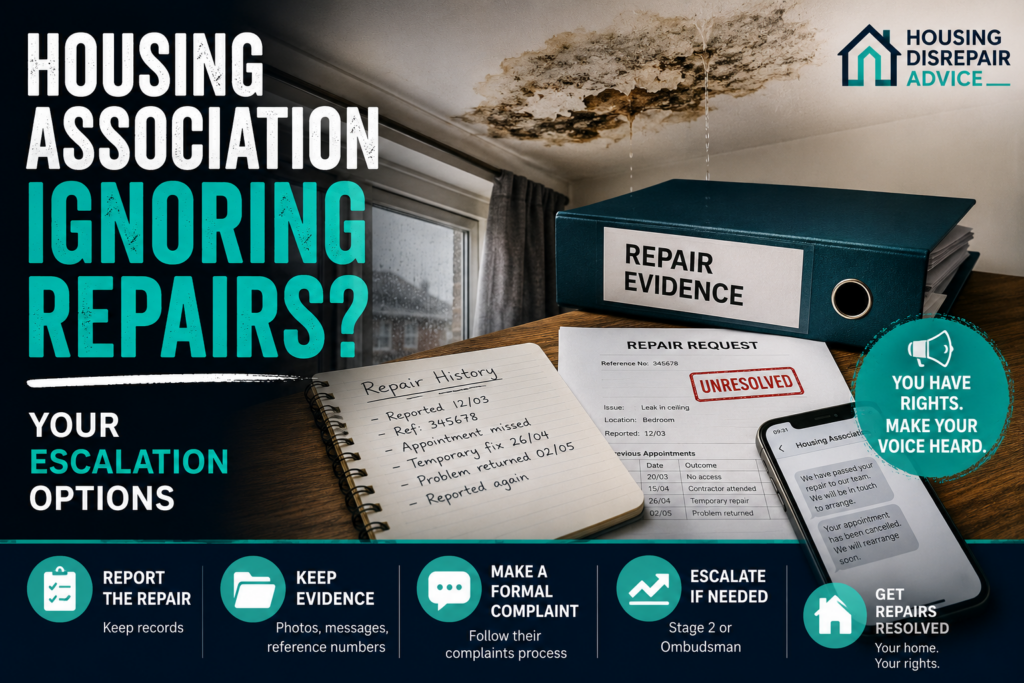
Reporting the same repair again and again can become exhausting.
Perhaps your housing association has sent several contractors but the underlying problem remains. Maybe appointments keep being cancelled. Perhaps you have photographs, repair reference numbers and months of messages but still cannot get a clear answer about when the work will actually be completed.
If your housing association is ignoring repairs, repeatedly logging another repair request is not always the best next step.
There comes a point when the issue needs to be formally escalated.
Housing association tenants have rights relating to the condition of their homes, and social landlords have responsibilities when they become aware of repair problems.
This guide explains what you can do when repairs remain unresolved, what evidence to keep, how to use the complaints process and where you may be able to escalate the matter further.
What Repairs Is a Housing Association Responsible For?
The exact responsibilities depend on your tenancy and where you live, but housing associations are generally responsible for major parts of the property and essential installations.
In England, landlord repairing obligations commonly include:
- The structure and exterior of the property
- Roofs
- External walls
- Windows and external doors
- Drains and gutters
- Water installations
- Gas installations
- Electrical installations
- Toilets, baths and other sanitation
- Heating systems
- Hot water systems
Housing associations also have wider obligations relating to the safety and condition of rented homes.
Not every maintenance issue will automatically be the landlord’s responsibility. Tenants can be responsible for certain minor issues or damage they have caused.
However, where the defect falls within the housing association’s responsibility, reporting it is important because the landlord generally needs to know about the problem before it can be expected to investigate and deal with it.
If you want a broader explanation of what may constitute disrepair, read our guide Housing Association Disrepair Claims: What Tenants Need to Know.
Start With a Clear Repair Record
Before escalating anything, establish exactly what has happened.
Write down:
- When you first noticed the problem
- When you first reported it
- How you reported it
- Every repair reference you have received
- Dates contractors attended
- Dates appointments were cancelled or missed
- What work was attempted
- Whether previous repairs failed
- When you chased the housing association
- What responses you received
- What remains outstanding
You do not need a complicated spreadsheet.
A simple chronological list can be extremely useful.
For example:
5 March: Leak reported – reference 12345
12 March: Contractor attended but could not locate source
20 March: Leak reported again
4 April: Appointment cancelled
18 April: Contractor attended and sealed pipe
26 April: Leak returned
2 May: Housing association contacted again
That timeline immediately tells the story better than simply saying:
“I’ve been reporting this for months.”
Keep Photographs and Videos
Photographs are particularly important where the condition of the property changes over time.
Take clear photographs of:
- Damp
- Mould
- Water staining
- Cracks
- Damaged plaster
- Leaking pipes
- Rotten woodwork
- Damaged ceilings
- Broken windows
- Defective flooring
- Damaged belongings
Try to take photographs from similar positions as the problem develops.
That can help show whether a defect is getting worse despite repeated reports.
Video can be useful for issues such as active leaks, windows that will not close, loose flooring or other problems that are difficult to demonstrate with a still photograph.
Keep the original files where possible.
Do Not Let Failed Repairs Reset the Clock
One of the most frustrating situations tenants experience is repeated temporary repairs.
A contractor attends.
Something is patched or painted.
The repair is marked as completed.
Then the problem returns.
If this happens, refer back to the original repair history rather than treating every recurrence as an entirely new issue.
Explain that:
- The problem has previously been reported
- Work has already been attempted
- The attempted repair has failed
- The underlying problem remains unresolved
This can be particularly important with recurring damp, mould and leaks.
Painting over mould, for example, may improve how a wall looks temporarily but does not necessarily deal with whatever is causing the moisture.
A Repair Request and a Formal Complaint Are Not the Same Thing
This distinction matters.
Reporting:
“My bedroom ceiling is leaking.”
is normally a repair or service request.
Saying:
“I have reported this leak repeatedly since March, repairs have failed and I am dissatisfied with how the housing association has handled the matter. I want this treated as a formal complaint.”
is different.
If your housing association keeps treating every contact as another repair request, consider stating clearly that you are making a formal complaint about its handling of the unresolved repairs.
That moves the issue into the landlord’s complaints procedure.
How to Make a Strong Formal Complaint
You do not need complicated legal terminology.
A useful complaint should explain:
1. What is wrong
Describe the unresolved repair clearly.
2. When the housing association was first told
Include the date if you have it.
3. What has happened since
List appointments, attempted repairs, cancellations and previous reports.
4. What remains unresolved
Be specific.
5. How it is affecting the property
Explain whether rooms cannot be properly used, belongings have been damaged or conditions are worsening.
6. Any particular safety concerns
Make the landlord aware if children, elderly residents, disabled household members or anyone with relevant vulnerabilities may be particularly affected.
7. What you want the housing association to do
For example:
- Investigate the underlying cause
- Complete outstanding repairs
- Provide a clear schedule of works
- Explain previous delays
- Correct inaccurate repair records
- Consider damage resulting from the disrepair
Keep the complaint factual.
A detailed timeline supported by photographs and repair references is usually more useful than an angry message with no dates or evidence.
What Happens After You Make a Complaint in England?
Housing associations in England that fall within the Housing Ombudsman Scheme must follow the Housing Ombudsman’s statutory Complaint Handling Code.
The process should normally contain two stages.
Stage 1
The complaint should normally be acknowledged, defined and logged within 5 working days.
A full Stage 1 response should normally be issued within 10 working days of the complaint being acknowledged.
Stage 2
If you remain dissatisfied, you can ask for the complaint to be escalated.
A Stage 2 request should normally be acknowledged, defined and logged within 5 working days.
The final Stage 2 response should normally be issued within 20 working days of acknowledgement.
There can be circumstances where additional time is needed, particularly with complex complaints, but the housing association should explain why.
A housing association should not simply allow a complaint to disappear because repairs are still outstanding.
Importantly, the complaint response and the physical repair work are separate things.
The landlord should still respond to the complaint while continuing to track and complete outstanding repairs.
What Should You Do If the Stage 1 Response Is Poor?
Do not assume a Stage 1 response ends the matter.
Read it carefully.
Ask:
- Has every repair been addressed?
- Has the landlord acknowledged previous failed repairs?
- Does the timeline match your records?
- Has it explained the delay?
- Is there a clear repair plan?
- Are there dates for outstanding work?
- Has it addressed the impact on your household?
- Has it responded to everything you complained about?
If significant issues remain unresolved, request escalation to Stage 2.
You do not need to write the entire complaint again.
Explain which parts remain unresolved and why you are dissatisfied with the Stage 1 response.
When Can You Contact the Housing Ombudsman?
In England, the Housing Ombudsman deals with complaints concerning social landlords, including housing associations.
Residents can contact the Housing Ombudsman during the complaints process for advice.
After completing the landlord’s complaints procedure, you may be able to ask the Ombudsman to investigate the complaint if you remain dissatisfied.
The Ombudsman can consider matters including:
- Repairs
- Property condition
- Damp and mould
- Complaint handling
- Communication
- Unreasonable delays
- Failure to follow policies
The Ombudsman does not simply look at whether a contractor eventually visited.
It can consider how the housing association handled the matter as a whole.
What If Your Housing Association Is Not Responding to the Complaint?
Do not endlessly restart the process.
Keep evidence showing:
- When the complaint was submitted
- How it was submitted
- Any acknowledgement received
- When the response deadline should have passed
- Every attempt you made to chase it
If your landlord fails to respond within its complaint process, the Housing Ombudsman can provide information about progressing a complaint.
A lack of response should not become a dead end.
Awaab’s Law and Housing Associations in England
Since 27 October 2025, social housing tenants in England have additional protections under Awaab’s Law.
Housing associations are included within the social rented sector.
The first phase currently applies to:
- Emergency hazards
- Damp and mould hazards presenting a significant risk of harm
Potential emergency hazards must be investigated quickly and, where an emergency hazard exists, the landlord must take action to make the home safe within the required timeframe.
Emergency hazards are subject to a maximum 24-hour timeframe.
Where damp and mould may present a significant risk of harm, housing associations generally have fixed requirements including investigation within 10 working days and providing the tenant with a written summary following the investigation.
Where a significant hazard is identified, required safety work must then begin within the statutory timescales.
This does not mean every ordinary housing repair must be completed within 24 hours or 10 working days.
The Awaab’s Law timescales depend on the nature and seriousness of the hazard.
Further significant hazards — including electrical hazards, fire risks, excess heat and cold and structural collapse — are due to enter the regime from 30 November 2026.
Those additional Phase 2 requirements are not yet in force at the time of writing.
Do Not Ignore a Serious or Emergency Hazard While Complaining
The complaints process should not replace emergency reporting.
If a problem may create an immediate risk to health or safety, use your housing association’s emergency repair procedure.
Examples might include:
- Major uncontrolled water leaks
- Dangerous electrical faults
- Serious structural problems
- An insecure property
- Significant flooding
- Immediate fire-related hazards
If there is an immediate danger to life, contact the emergency services.
What About Housing Association Tenants in Wales?
The process is different in Wales.
Housing association tenants in Wales are protected by the Renting Homes (Wales) Act 2016, which places obligations on landlords regarding repairs and the fitness of rented homes.
If repairs remain unresolved, tenants should first report the problem to their housing association and allow a reasonable opportunity for it to respond.
Use the housing association’s complaints procedure if the repair is then delayed, repeatedly mishandled or ignored.
The Public Services Ombudsman for Wales can investigate complaints involving councils and housing associations, including complaints relating to:
- Failure to carry out repairs
- Delayed repairs
- Missed appointments
- Failure to resolve reported repair problems within a reasonable period
Do not use the English Housing Ombudsman route for a Welsh housing association tenancy.
Should You Stop Paying Rent Because Repairs Have Not Been Done?
Generally, no.
Withholding rent because repairs are outstanding can create rent arrears and potentially make your situation worse.
Keep paying your rent unless you have received specific legal advice telling you to do otherwise.
Use the repair, complaint, Ombudsman and legal routes available to you instead.
What If the Disrepair Has Been Going On for Months?
Long-running repairs deserve a clear record.
If problems have remained unresolved despite repeated reports, consider gathering everything together:
- Repair references
- Photographs
- Videos
- Emails
- Text messages
- Complaint responses
- Contractor reports
- Appointment records
- Evidence of failed repairs
- Evidence of damaged belongings
- Your repair timeline
Our guide What Happens After You Report Housing Disrepair? explains the wider process tenants may encounter after reporting problems.
You can also read Housing Disrepair Claims: What Counts and What Should You Do First? for a broader explanation of when unresolved property conditions may potentially become a housing disrepair matter.
Can Housing Association Tenants Claim Compensation?
Potentially, depending on the individual circumstances.
Compensation is not automatic simply because a repair took longer than expected.
Factors can include:
- The nature of the disrepair
- How serious it was
- How long it remained unresolved
- When the housing association became aware of it
- The landlord’s response
- Whether repairs repeatedly failed
- The effect on the tenant’s use of the home
- Damage to belongings
- Available evidence
- The applicable law and tenancy terms
In some cases, a complaint through the Housing Ombudsman may result in financial redress being ordered.
A housing disrepair legal claim is a different process and should be considered on its own facts.
Avoid websites promising an exact compensation figure before anyone has properly assessed the circumstances.
A Simple Housing Association Repair Escalation Checklist
If your housing association is ignoring repairs:
- Report the repair clearly
- Keep the repair reference
- Follow telephone conversations up in writing
- Photograph and video the problem
- Keep a dated repair timeline
- Record missed appointments
- Record failed repairs
- Save emails, texts and portal messages
- Make a formal complaint if the problem remains unresolved
- Check the Stage 1 response carefully
- Escalate to Stage 2 where necessary
- Contact the Housing Ombudsman in England where appropriate
- Use the Public Services Ombudsman for Wales route for Welsh housing association complaints
- Report emergency hazards immediately
- Seek independent advice if serious disrepair continues
You Do Not Have to Keep Reporting the Same Repair Forever
Giving your housing association the opportunity to investigate a repair is reasonable.
Being trapped in an endless cycle of new repair references, cancelled appointments, temporary fixes and unanswered messages is not the same thing.
Once a housing association has been told about a problem, what happens next matters.
If repairs continue to be ignored, build a clear evidence trail, move the matter into the formal complaints process and escalate it appropriately.
And if serious housing disrepair remains unresolved despite repeated reports and complaints, obtaining independent advice can help you understand what further options may be available.
This article provides general information and does not constitute individual legal advice. Repair responsibilities, complaint routes and legal options depend on the location, tenancy and individual circumstances.
Housing Association Disrepair Claims: What Tenants Need to Know → HDA housing association disrepair guideWhat Happens After You Report Housing Disrepair? → HDA reporting-disrepair guideHousing Disrepair Claims: What Counts and What Should You Do First? →
HDA housing disrepair claims guide
Housing Ombudsman’s statutory Complaint Handling Code → Housing Ombudsman Complaint Handling CodeAwaab’s Law → GOV.UK Awaab’s Law guidance for social housing tenantsPublic Services Ombudsman for Wales → Housing repairs guidance for Wales