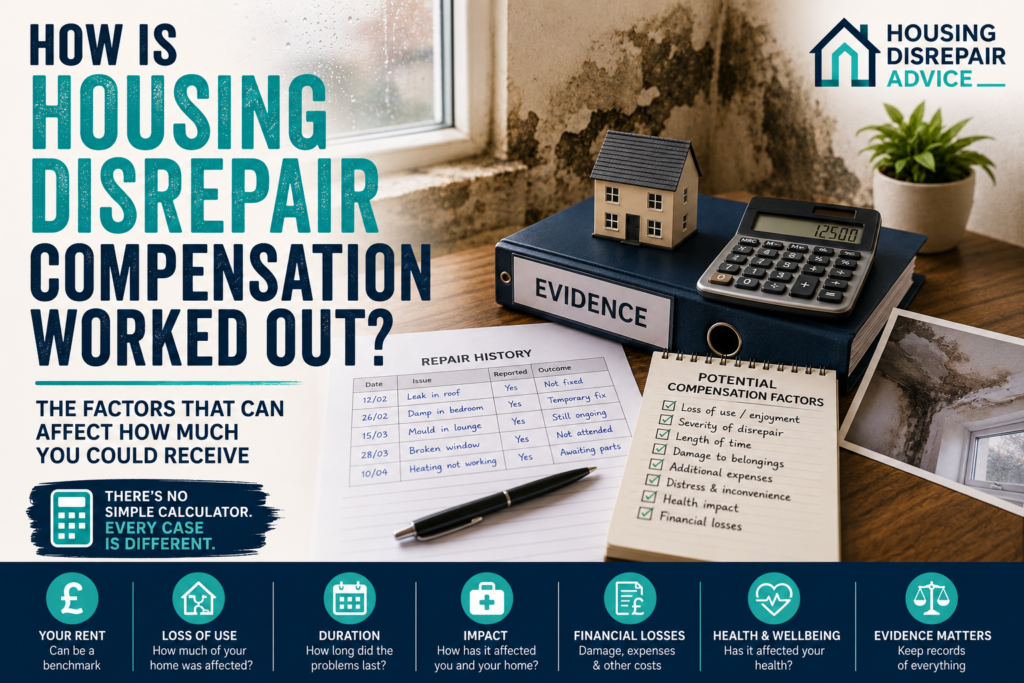
If you search online for a housing disrepair compensation calculator, you may find websites suggesting that entering your rent, the number of affected rooms and how long the problem lasted can produce an estimated payout.
The reality is more complicated.
There is no single official calculator that can tell every tenant exactly how much housing disrepair compensation they will receive.
Two tenants could have similar repair problems but receive different outcomes because the severity, duration, evidence and impact on their homes are different.
However, there are factors that are commonly considered when compensation is assessed.
Understanding those factors can give you a much clearer idea of how a potential housing disrepair claim may be valued.
What Can Housing Disrepair Compensation Cover?
Depending on the circumstances, compensation may take account of several different types of loss.
These can include:
- Loss of use or enjoyment of your home
- The seriousness of the disrepair
- How long the problems continued
- Damage to furniture or belongings
- Additional expenses caused by the disrepair
- Distress and inconvenience
- Health problems caused or made worse by housing conditions
- Lost earnings or other financial losses in appropriate cases
Not every claim includes every category.
The evidence available and the individual circumstances matter.
Is Housing Disrepair Compensation Based on Your Rent?
Rent can be an important factor, particularly where the disrepair substantially affects your ability to use part of your home.
For example, imagine that persistent water penetration makes a bedroom effectively unusable.
A tenant is still paying rent for the whole property despite being unable to properly use that room.
The rent can therefore provide a useful benchmark when considering the loss of use or enjoyment experienced during the relevant period.
But this does not mean tenants simply receive their rent back.
Compensation is normally assessed according to how significantly the disrepair affected the home and for how long.
How Much of the Property Could You Use?
This is one of the most important questions.
Consider the difference between these situations.
Example 1: Minor Localised Damage
There is staining and damaged plaster in one corner of a bedroom, but the room remains usable.
Example 2: Significant Bedroom Disrepair
Persistent damp and mould affects walls, furniture and bedding to such an extent that the bedroom cannot reasonably be used as intended.
Example 3: Several Rooms Affected
A serious leak causes damage to a bedroom, bathroom and living room over an extended period.
Although all three situations involve disrepair, the impact on the tenant’s use of the property is clearly different.
The greater the loss of use, the more significant that factor may become when compensation is considered.
Does the Housing Ombudsman Use Percentages?
For council and housing association tenants in England, the Housing Ombudsman now publishes detailed guidance explaining how it may calculate compensation where landlord maladministration results in the loss of use of part of a home.
Its current guidance uses the rent charged as a benchmark and assigns percentages to rooms where their use has been substantially impaired.
The Housing Ombudsman’s current guide uses:
- Living room – 20% of weekly rent
- Bedroom – 20%
- Kitchen – 30%
- Bathroom – 30%
- Bathroom where another WC is available – 20%
Where the entire property is affected, its calculation can reach 100% of the rent charged before considering other relevant factors.
You can read the Housing Ombudsman’s compensation guidance directly.
But There Is an Important Catch
These percentages are the Housing Ombudsman’s approach to compensation in its own casework.
They are not a universal court tariff and should not be treated as a guaranteed housing disrepair claim formula.
A legal housing conditions claim can involve different considerations, evidence and principles.
That is why websites claiming that a few numbers can automatically tell you exactly what your claim is worth should be treated cautiously.
An Example Housing Disrepair Compensation Calculation
A simple example helps explain the principle.
Imagine a social housing tenant pays:
£120 per week rent
A landlord failure leaves their living room substantially unusable for:
20 weeks
Using the Housing Ombudsman’s current 20% benchmark for a living room:
£120 × 20% = £24 per week
Over 20 weeks:
£24 × 20 = £480
That could create a starting figure of £480 for the loss of use of that room under the Ombudsman’s methodology.
But it would still not automatically mean the tenant receives £480.
The Ombudsman also considers factors such as when the landlord should reasonably have completed the repair, temporary accommodation, the evidence available and whether anything reduced or increased the impact.
Additional compensation could potentially also be considered for other effects such as distress and inconvenience.
Equally, a court-based housing disrepair claim is not required to use the Ombudsman’s percentages.
So this example demonstrates how a calculation might work rather than predicting the value of an individual claim.
How Long Did the Disrepair Last?
Duration can make a substantial difference.
A leaking roof that remains unresolved for three weeks is very different from a leaking roof that continues for eighteen months.
However, the relevant period is not necessarily calculated from the first day the defect physically appeared.
An important question is:
When did the landlord know about the problem?
Tenants should therefore keep evidence showing when repairs were first reported.
Our guide on how to report repairs to your landlord properly explains why repair references, emails and written records can become so important.
A landlord must normally be given a reasonable opportunity to investigate and deal with a reported problem.
What counts as reasonable depends on the repair and its urgency.
You can read more in our guide: How Long Should a Landlord Take to Do Repairs?.
Does the Severity of the Disrepair Affect Compensation?
Yes.
The nature of the defect matters as well as its duration.
Examples of potentially serious disrepair can include:
- Persistent damp and mould
- Significant water penetration
- Major roof leaks
- Unsafe electrical installations
- Serious structural defects
- Broken heating during cold weather
- Faulty plumbing or sanitation
- Rotten windows allowing substantial water penetration
- Collapsing ceilings
- Severe pest infestations associated with defects in the property
A cosmetic crack will not normally have the same impact as a ceiling at risk of collapse.
Similarly, a small area of mould that appears briefly will not necessarily be assessed in the same way as extensive mould affecting several rooms for months.
The actual condition of the property needs to be considered.
What About Damage to Belongings?
Housing disrepair can sometimes damage tenants’ possessions.
Examples include:
- Beds and mattresses damaged by mould
- Clothing affected by damp
- Flooring damaged by leaks
- Furniture affected by water penetration
- Electrical items damaged by water
- Decorations damaged by unresolved defects
Where you believe belongings have been damaged because of housing conditions, keep evidence.
Take photographs before throwing items away where possible.
Keep receipts, invoices or bank records if you still have them.
Do not exaggerate the value of damaged items.
An accurate and evidenced schedule of losses is far stronger than estimating that everything in a room was worth several thousand pounds without supporting information.
Our guide on what evidence to keep for housing repairs explains how to build a useful repair record.
Can Additional Expenses Be Included?
Potentially.
Tenants can sometimes incur additional costs because repairs have not been completed.
Examples might include:
- Higher heating costs because of defective heating
- Additional electricity used by temporary heaters
- Launderette costs
- Replacing damaged essential items
- Extra travel expenses
- Prescription or medical travel costs where relevant
- Other unavoidable expenditure directly connected to the housing conditions
Shelter’s current guidance confirms that tenants may be able to seek compensation for financial losses and expenses arising from poor housing conditions.
You can read its guidance on compensation for poor repairs and conditions.
Keep receipts and bills.
Small pieces of evidence accumulated over several months can make a significant difference when trying to establish what was actually spent.
What About Health Problems?
Housing conditions can sometimes affect physical or mental health.
Examples may include respiratory problems associated with severe damp and mould, injuries caused by defective parts of a property or existing conditions being aggravated by poor housing conditions.
But proving that disrepair caused or worsened a medical condition is different from simply proving that the repair existed.
Medical evidence may be required.
The circumstances of each person are different, and health-related damages should not simply be added to an online compensation calculator.
Personal injury claims can also have different legal time limits from ordinary housing disrepair claims.
If there is a significant health element to a potential claim, obtaining appropriate legal advice is important.
Does Distress and Inconvenience Count?
It can.
Living with unresolved repairs can create significant disruption.
A tenant may experience:
- Months of repeatedly chasing repairs
- Contractors failing to attend
- Rooms that cannot be properly used
- Constant cleaning because of mould
- Moving furniture whenever it rains
- Sleeping in another room
- Repeated complaint correspondence
- Uncertainty about when repairs will happen
For social housing complaints in England, the Housing Ombudsman can award compensation recognising avoidable distress, inconvenience and additional time and trouble caused by landlord failures.
Its guidance considers factors including the severity and duration of the problem and relevant vulnerabilities within the household.
That is another reason two apparently similar cases can produce different outcomes.
Do Children or Vulnerable Household Members Affect the Calculation?
Individual circumstances can matter.
For example, the consequences of prolonged loss of heating might be particularly serious in a household containing:
- Babies or young children
- Older people
- Disabled residents
- People with relevant health conditions
The Housing Ombudsman’s current guidance expressly recognises that disabilities and vulnerabilities can affect how seriously landlord failures impact a household.
This does not mean that having a vulnerable person in the property automatically generates a fixed additional payment.
It means the real-world impact should be considered rather than treating every household identically.
What Evidence Helps Work Out a Housing Disrepair Claim?
Useful evidence can include:
- Photographs
- Videos
- Repair reference numbers
- Emails
- Text messages
- Online repair portal screenshots
- Complaint responses
- Contractor records
- Surveyor reports
- Medical evidence where relevant
- Receipts and invoices
- Evidence of damaged possessions
- A dated repair timeline
The legal Pre-Action Protocol for Housing Conditions Claims in England specifically provides for information about the housing conditions, expert evidence and schedules of financial loss to be exchanged before litigation where appropriate.
You can read the official Pre-Action Protocol for Housing Conditions Claims.
Wales has its own Pre-Action Protocol for Housing Disrepair Cases.
Is Compensation Different in England and Wales?
There are differences in the legal framework.
In England, housing condition claims may involve repairing obligations under the Landlord and Tenant Act 1985 as well as the requirement for relevant rented homes to be fit for human habitation.
Wales operates under the Renting Homes (Wales) Act 2016, which includes repairing and fitness-for-human-habitation obligations for landlords.
The underlying principle remains that compensation depends on the actual circumstances rather than an automatic nationwide payout table.
Tenants in England and Wales should therefore make sure the legal route being considered applies to where their property is located.
Housing Ombudsman Compensation and Court Compensation Are Not the Same Thing
This is worth repeating because the distinction is often blurred online.
The Housing Ombudsman investigates complaints involving social landlords in England.
It can order financial remedies where landlord maladministration has caused an adverse impact.
A housing disrepair or housing conditions legal claim is different.
A court can consider damages arising from breaches of legal obligations.
An Ombudsman award therefore should not automatically be treated as the amount a court would award — or vice versa.
They are different processes.
Can Private Tenants Receive Housing Disrepair Compensation?
Potentially, yes.
Housing disrepair rights are not limited to council and housing association tenants.
Private landlords also have repairing obligations.
A private tenant who has properly reported significant repair problems that the landlord then fails to deal with may have legal options depending on the circumstances.
However, private tenants cannot generally use the Housing Ombudsman route that applies to social landlords.
Other routes may include the landlord or letting agent complaints process, a letting agent redress scheme where applicable, local authority enforcement and legal action.
The way compensation is assessed will depend on the route being used.
Why Online Housing Disrepair Calculators Can Be Misleading
A calculator might ask:
How much rent do you pay?
How many rooms were affected?
How many months did the problem last?
Those questions are relevant.
But they leave out many others.
For example:
- When did the landlord first receive notice?
- What repairs were actually required?
- Was the room completely unusable or merely affected?
- Was temporary accommodation provided?
- Did the tenant allow reasonable access?
- Were repairs attempted?
- Did the problem recur?
- What evidence exists?
- Were belongings damaged?
- Were additional expenses incurred?
- Was there a proven health impact?
- Which legal route applies?
Without answering those questions, an exact payout figure can create false expectations.
A responsible assessment looks at the evidence rather than simply producing the largest number possible.
So How Is Housing Disrepair Compensation Actually Worked Out?
There is no single calculation that applies to every case.
Instead, the potential value normally develops from a combination of factors:
The rent
Provides a possible benchmark when considering loss of use.
The extent of the problem
How much of the home was affected?
The severity
How serious were the conditions?
The duration
How long did the relevant problem remain unresolved after the landlord was aware of it?
The impact
How much did the disrepair interfere with normal use of the property?
Financial losses
Were there additional costs or damaged belongings?
Health consequences
Is there appropriate evidence that the conditions caused or worsened illness or injury?
The tenant’s evidence
Can the repair history and losses actually be demonstrated?
Together, these factors provide a much more realistic picture than a headline compensation calculator.
Think Evidence First, Compensation Second
It is understandable to want to know what a housing disrepair claim might be worth.
But the strongest place to start is usually not the compensation figure.
Start with the evidence.
Establish:
- What is wrong with the property
- When it was first reported
- What the landlord has done
- What remains unresolved
- How long the problem has continued
- Which rooms are affected
- How the conditions have affected the household
- What financial losses have occurred
Once those facts are clear, it becomes much easier to assess what options may be available and how compensation could potentially be approached.
If you have reported significant housing repairs and the problems remain unresolved, Housing Disrepair Advice can review what has happened and explain the next steps that may be available.
This article provides general information and should not be treated as individual legal advice. Compensation and legal outcomes depend on the facts, evidence, tenancy, location and applicable law in each individual case.
How Long Should a Landlord Take to Do Repairs?
https://housing-disrepair-advice.org/how-long-landlord-take-to-do-repairs/
Housing Ombudsman compensation guidance
https://www.housing-ombudsman.org.uk/landlords-info/guidance-notes/compensation-guidance/