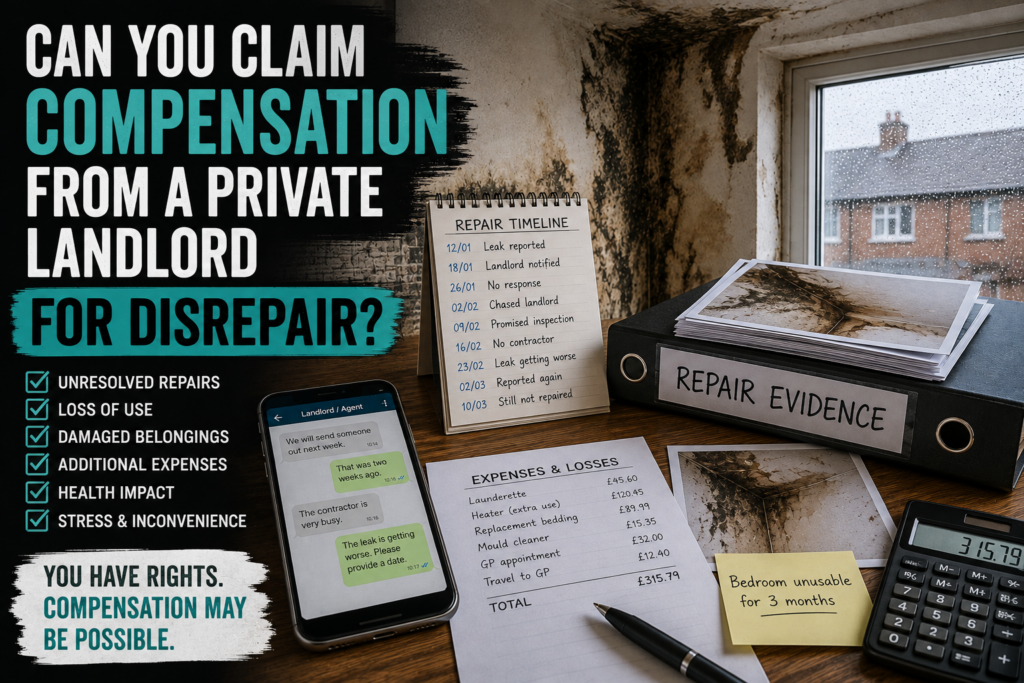
If your private landlord has left serious repairs unresolved, you may be wondering whether you can claim compensation.
In some circumstances, yes — a private tenant may be able to claim compensation from a landlord for housing disrepair.
But compensation is not automatic simply because something in the property broke.
Usually, the important questions are:
- Was the landlord responsible for the repair?
- Did the landlord know about the problem?
- Were they given a reasonable opportunity to deal with it?
- Did the problem remain unresolved?
- How serious was the disrepair?
- How long did it continue?
- How did it affect you or your use of the home?
- What evidence do you have?
Those factors can determine whether a potential claim exists and how compensation may be assessed.
Private Tenants Can Have Housing Disrepair Rights
Housing disrepair claims are not restricted to council or housing association tenants.
Private landlords also have legal responsibilities for many parts of rented properties.
These commonly include:
- The structure and exterior
- Roofs
- External walls
- Pipes and drains
- Sinks, baths and sanitary fittings
- Heating
- Hot water
- Gas installations
- Electrical wiring
Private rented homes in England must also meet legal requirements concerning fitness for human habitation.
In Wales, landlords have repairing and fitness obligations under the Renting Homes (Wales) Act 2016.
If your landlord is responsible for a defect and fails to deal with it properly after becoming aware of it, compensation may potentially become part of the available remedies.
What Needs to Happen Before Compensation Can Be Considered?
One of the most important things is notice.
Your landlord generally needs to know that there is a repair problem.
If a pipe has been leaking behind a wall for six months but neither you nor the landlord knew about it, that is very different from repeatedly reporting water pouring through the ceiling while nothing is done.
That is why written repair reports are so important.
Keep:
- Emails
- Text messages
- WhatsApp conversations
- Letting agent messages
- Repair portal reports
- Letters
- Repair reference numbers
If you report a problem by telephone, follow it up in writing.
Something as simple as:
Further to our telephone conversation today, I am confirming that I reported the leak in the bedroom ceiling and attached photographs showing the damage.
can later provide useful evidence of when the landlord became aware of the problem.
Does the Landlord Have to Be Given Time to Repair It?
Yes.
A landlord normally needs a reasonable amount of time to investigate and carry out the necessary work.
There is not one fixed legal deadline that applies to every private rented repair.
What is reasonable depends on the circumstances.
A major electrical danger may require extremely urgent action.
A roof leak causing significant water penetration should not simply be left indefinitely.
A minor repair that requires specialist parts may reasonably take longer.
Compensation is therefore not calculated simply from the day something first went wrong.
When the landlord received notice and when they should reasonably have completed the work can be important.
What Can Compensation Cover?
Housing disrepair compensation can potentially relate to several different consequences of poor housing conditions.
These may include:
- Loss of use or enjoyment of your home
- Inconvenience
- Financial losses
- Damage to belongings
- Additional expenses
- Health problems caused or worsened by the conditions
- Loss of earnings in appropriate cases
Not every case includes all of these.
The circumstances and evidence determine what may be relevant.
Compensation for Loss of Use of Your Home
One of the most important areas is how much the disrepair interfered with your ability to use the property normally.
Imagine two private tenants with leaks.
Tenant One
A small leak causes staining in the corner of a hallway.
The hallway remains completely usable.
Tenant Two
Water repeatedly enters a bedroom, damaging the ceiling and creating extensive damp and mould.
The tenant eventually stops using the bedroom.
Both tenants have experienced a leak.
But the impact on their homes is very different.
Where significant disrepair substantially prevents a tenant from using part of the property, compensation may reflect that loss of use or enjoyment.
Can You Get Some of Your Rent Back?
Potentially.
Where repairs cause serious disruption, a reduction reflecting the affected use of the property is sometimes described as a rent abatement.
This does not mean you simply receive all the rent you paid while repairs were outstanding.
The extent of the problem matters.
For example, a court might consider how much of the property could reasonably be used during the relevant period.
The impact of one partially affected room is very different from a situation where several essential rooms cannot properly be used.
There is no universal online calculator that can accurately determine this for every private tenant.
Can You Claim for Damaged Belongings?
Potentially.
Disrepair can damage personal possessions.
Common examples include:
- Mattresses affected by mould
- Clothing damaged by damp
- Furniture damaged by leaks
- Carpets or flooring affected by water
- Electrical items damaged by water penetration
- Children’s belongings affected by mould
If this happens, take photographs.
Do not throw damaged possessions away before recording what happened unless doing so is necessary for health or safety.
Keep:
- Photographs
- Receipts
- Bank statements
- Purchase confirmations
- Replacement invoices
If you no longer have the original receipt, other evidence may sometimes help demonstrate what the item was and its approximate value.
Be realistic.
Claiming that a ten-year-old sofa was worth exactly what a brand-new replacement costs may not necessarily be accepted.
What About Additional Expenses?
Poor housing conditions can sometimes cost tenants money.
For example, you might experience:
- Higher electricity bills from temporary heaters
- Launderette expenses
- Additional cleaning costs
- Replacement bedding
- Travel expenses
- Costs associated with temporarily staying elsewhere
- Prescription or medical travel expenses
- Other reasonable expenditure caused directly by the disrepair
Keep receipts and bills.
A claim saying:
“The repair cost me loads of money.”
is difficult to assess.
A folder containing dated receipts and an explanation of why each expense occurred is considerably stronger.
Can You Claim for Stress and Inconvenience?
Potentially.
Living with unresolved housing problems can disrupt everyday life.
Examples might include:
- Constantly chasing the landlord
- Waiting for contractors who do not arrive
- Moving furniture whenever it rains
- Sleeping in a different room
- Cleaning recurring mould
- Being unable to use part of the property
- Repeatedly taking time off for repair appointments
- Living with uncertainty about when work will happen
The seriousness and duration of that disruption can be relevant.
However, compensation for inconvenience is not simply a fixed amount per phone call or missed appointment.
The overall impact needs to be considered.
What If the Disrepair Has Affected Your Health?
Health problems can potentially form part of a housing conditions claim.
For example, severe damp, mould, excessive cold or unsafe conditions may in some circumstances cause or worsen health problems.
But proving that the property was in poor condition is not automatically the same as proving that the condition caused an illness.
Medical evidence can become important.
Depending on the circumstances, useful evidence might include:
- GP records
- Hospital records
- Prescription records
- Photographs of conditions
- Medical letters
- Evidence showing when symptoms developed
Claims involving personal injury can also have different legal time limits from other housing disrepair damages.
If there is a significant health element, proper legal assessment is particularly important.
Does the Length of Time Matter?
Absolutely.
Duration can have a major effect.
A repair that was reasonably resolved within a short period is very different from a problem the landlord allowed to continue for twelve months.
But remember that the relevant period may not necessarily begin on the first day the defect existed.
The question can be when the landlord knew — or should appropriately have known — about the problem and how long they then reasonably required to deal with it.
That makes your repair timeline valuable.
What If Repairs Were Attempted but Kept Failing?
A landlord sending a contractor does not necessarily end the matter.
Imagine this pattern:
January: Leak reported
February: Contractor attends and seals an area
March: Leak returns
March: Landlord told again
April: Contractor paints damaged ceiling
May: Leak returns again
June: Still unresolved
The landlord may have attempted repairs.
But the underlying problem may still have remained unresolved.
Keep evidence of every failed repair.
Photograph the condition before and after work where possible.
What If Your Landlord Eventually Fixes Everything?
The eventual completion of repairs does not necessarily erase what happened previously.
For example, suppose your landlord was repeatedly told about significant damp caused by water penetration.
The problem continued for eight months.
The landlord then finally fixed the defective roof.
The repair is now complete.
There may still be a question about what happened during those previous months.
Whether compensation can be pursued depends on matters including:
- Notice
- Duration
- Responsibility
- The severity of the conditions
- The landlord’s response
- Available evidence
- Losses suffered
A late repair does not automatically mean there was never a potential claim.
Can You Claim After Moving Out?
Potentially.
A tenant does not necessarily lose every right simply because the tenancy has ended.
If significant disrepair affected you during the tenancy, a claim may potentially still be considered afterwards.
Evidence becomes particularly important once you no longer have access to the property.
Before leaving, where appropriate, keep:
- Photographs
- Videos
- Tenancy documents
- Repair messages
- Landlord correspondence
- Letting agent correspondence
- Check-in and check-out reports
- Council reports
- Evidence of damaged belongings
Legal time limits apply, so do not leave potential claims indefinitely.
Is There a Minimum Compensation Amount?
No.
There is no standard minimum payment that every private tenant receives.
Likewise, there is no guaranteed £5,000, £10,000 or other headline figure simply because a tenant has damp, mould or a leak.
Claims should be valued from the evidence.
Websites or advertisements promising large payouts before anyone has established the facts should be treated cautiously.
The value can depend on:
- Rent
- Severity
- Duration
- Number of affected rooms
- Loss of use
- Financial losses
- Damaged belongings
- Health effects
- Strength of evidence
Two apparently similar homes can therefore produce very different outcomes.
Do You Need to Go Straight to Court?
Not necessarily.
Court proceedings should not automatically be the first step.
A tenant may initially try to resolve the problem directly with the landlord.
Depending on the circumstances, this might involve requesting:
- Completion of repairs
- Reimbursement of documented losses
- A rent reduction
- Compensation
- An agreed timetable for remedial work
If agreement cannot be reached and legal action is appropriate, there are formal steps that should normally be followed before proceedings begin.
In England, the Pre-Action Protocol for Housing Conditions Claims applies to housing conditions claims and encourages the parties to exchange information, consider repairs and attempt to resolve compensation issues before litigation.
Wales has a separate housing disrepair pre-action protocol.
Do You Need Evidence Before Making a Claim?
Yes — and the better the evidence, the easier it is to understand what actually happened.
Useful evidence includes:
- Photographs
- Videos
- Emails
- Text messages
- WhatsApp messages
- Repair reports
- Letting agent correspondence
- Contractor appointments
- Council inspection reports
- Surveyor reports
- Medical evidence where relevant
- Receipts
- Utility bills
- Evidence of damaged belongings
- A repair timeline
Do not wait until several months later and then try to reconstruct everything from memory.
Start building the evidence while the problem is happening.
What If You Rent Through a Letting Agent?
The landlord’s underlying repairing responsibilities do not simply disappear because a letting agent manages the property.
Report repairs through the appropriate management route and keep records.
If an agent fails to handle complaints properly, private renters may also have access to an approved letting agent redress scheme where the issue falls within that scheme’s remit.
That is different from making a housing disrepair court claim against the landlord.
The appropriate route depends on what has gone wrong and who is responsible.
Can the Council Award You Housing Disrepair Compensation?
Usually, council environmental health enforcement and a compensation claim are separate things.
For serious hazards in private rented housing, the local authority may inspect and take enforcement action against the landlord.
That can be extremely valuable in getting unsafe conditions dealt with.
But an environmental health inspection does not automatically calculate and award your housing disrepair compensation.
It may, however, provide useful evidence about the condition of the property.
Private Landlord Compensation in Wales
Private tenants — known as contract-holders under Welsh legislation — also have rights concerning repairs and property condition.
The Renting Homes (Wales) Act 2016 requires landlords to meet repairing obligations and ensure relevant homes are fit for human habitation.
Where a landlord becomes aware that repairs are needed, they generally have a reasonable period to carry them out.
If the landlord breaches those obligations, remedies can potentially include damages for consequences such as:
- Inability to use the home normally
- Damage to belongings
- Financial loss
- Injury or illness where appropriately established
The legal framework differs from England, which is why the location of the property matters when assessing a potential claim.
What Should You Do Before Asking How Much Your Claim Is Worth?
Before focusing on a compensation figure, answer these questions:
1. What exactly is wrong with the property?
2. Is the landlord responsible for repairing it?
3. When did you first report it?
4. Can you prove that report?
5. What did the landlord do afterwards?
6. How long did the problem continue?
7. Which rooms were affected?
8. Could you still use those rooms normally?
9. Were belongings damaged?
10. Did you spend money because of the problem?
11. Was anyone’s health affected?
12. What evidence do you have?
Those answers are considerably more valuable than putting your rent into an online calculator and being shown a large headline number.
Compensation Is About the Actual Impact
A private landlord failing to repair a property can potentially have serious consequences.
But a responsible housing disrepair assessment should not begin with:
“How much money can we promise?”
It should begin with:
“What happened, what should the landlord have done, and what evidence proves the impact?”
That approach protects tenants from unrealistic expectations while making genuine cases easier to understand.
If your private landlord has known about significant repair problems and they have remained unresolved for an unreasonable period, Housing Disrepair Advice can review the circumstances and explain what options may be available.
Private tenants have rights too.
And where a landlord has failed in their repairing obligations, compensation may be one part of putting things right.
This article provides general information and does not constitute individual legal advice. Eligibility, compensation and legal options depend on the property, tenancy, location, evidence and individual circumstances.