You reported the leak.
You sent photographs.
You chased the landlord.
You contacted the letting agent.
You were told somebody would come out.
Weeks later, the repair is still not done.
If your private landlord is ignoring repairs, repeatedly sending the same message is not your only option.
Private landlords have legal responsibilities for many repairs in rented homes, and tenants can take further steps when significant problems remain unresolved.
What you should do depends on the type of repair, how serious it is, how long the landlord has known about it and what action — if any — they have taken.
This guide explains how to create a clear repair record, escalate unresolved problems and understand the options that may be available if your landlord continues to ignore you.
First: Is the Repair the Landlord’s Responsibility?
Before escalating anything, establish whether the landlord is responsible for the problem.
Private landlords are generally responsible for important parts of a rented property, including:
- The structure and exterior
- Roofs
- External walls
- Drains and external pipes
- Water installations
- Sinks, basins and baths
- Toilets and sanitation
- Heating
- Hot water
- Gas installations
- Electrical wiring
The exact responsibility can depend on what has happened.
For example, a landlord would not normally be responsible for damage deliberately caused by a tenant.
But landlords cannot simply avoid major repairing obligations by writing something different into the tenancy agreement.
Private rented homes must also meet legal standards concerning their condition and safety.
Step 1: Report the Repair in Writing
If you have only reported the problem by telephone, create a written record now.
Email, text or message your landlord or letting agent.
Include:
- Your property address
- What the problem is
- Where it is located
- When you first noticed it
- When you previously reported it
- Whether it is getting worse
- Whether it presents a safety concern
- Photographs or videos where appropriate
You do not need legal terminology.
Something as straightforward as:
I first reported the leak in the bedroom ceiling on 4 June. The problem remains unresolved and water is continuing to enter the room when it rains. Please confirm when the repair will be inspected and completed.
creates useful evidence.
The important thing is proving that the landlord knew about the problem.
Step 2: Give the Landlord a Reasonable Opportunity to Respond
There is no universal rule saying every private landlord repair must be completed within a particular number of days.
The law generally looks at whether repairs have been completed within a reasonable time after the landlord became aware of them.
What is reasonable depends on the circumstances.
A dangerous electrical fault may require very rapid action.
A major water leak should not be left indefinitely.
A less urgent repair may reasonably require more time for an inspection, parts or specialist contractor.
Relevant factors include:
- The severity of the problem
- Whether anyone is at immediate risk
- Whether essential facilities are affected
- Whether the problem is causing further damage
- Who lives in the property
- What type of repair is required
- Whether specialist contractors are reasonably needed
The question is not simply:
“Has seven days passed?”
It is:
“Has the landlord responded reasonably to this particular problem?”
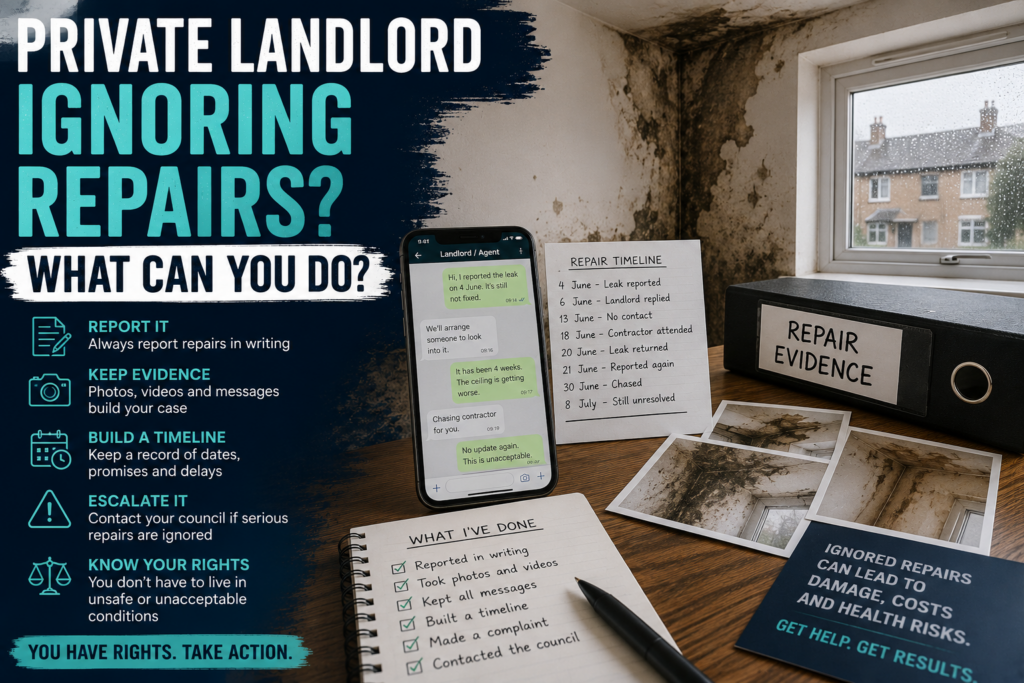
Step 3: Build a Repair Timeline
When tenants contact us about long-running repairs, one of the most useful things they can provide is a timeline.
It does not need to be complicated.
For example:
4 June – Leak first reported by text
6 June – Landlord replied saying contractor would contact me
13 June – No contact from contractor
14 June – Chased landlord
18 June – Contractor attended
20 June – Leak returned
21 June – Sent landlord new photographs
30 June – Chased again
8 July – Still unresolved
That tells the story immediately.
Compare that with:
“I’ve messaged him loads and he never does anything.”
The first version is far more useful if the matter later needs to be assessed by the council, an adviser, solicitor or court.
Step 4: Keep Evidence of the Property Condition
Take photographs.
Then keep taking them.
One photograph showing mould today may be helpful.
Photographs showing how it developed over three months can be considerably more useful.
Evidence might include:
- Damp and mould photographs
- Water staining
- Active leaks
- Cracked plaster
- Damaged ceilings
- Rotten windows
- Defective flooring
- Unsafe electrical fittings
- Broken heating systems
- Damaged belongings
Video can help with problems that are difficult to capture in a still image.
For example:
- Water entering during rainfall
- A window that cannot close
- Flooring moving when walked on
- Water running down a wall
- A ceiling dripping
Keep the original files where possible.
Step 5: Chase the Landlord Clearly — Not Constantly
Sending ten messages in a day rarely improves the evidence.
A better approach is to send clear follow-ups.
Refer to the previous report.
State what remains unresolved.
Ask for a specific response.
For example:
I reported this problem on 4 June and again on 21 June. It remains unresolved. Please confirm by Friday when the property will be inspected and what action will be taken.
If the repair becomes significantly worse, tell the landlord immediately rather than simply waiting for your previous deadline.
What If You Rent Through a Letting Agent?
If the letting agent manages repairs, contact them too.
Keep evidence of everything you send.
If the agent says:
“We are waiting for the landlord.”
record that.
If the landlord says:
“Speak to the agent.”
record that too.
Do not allow yourself to become trapped indefinitely between them.
Ultimately, identifying who has been told about the repair and what action they took is important.
If the letting agent handles the property and repeatedly fails to deal with your complaint properly, they should also have a complaints procedure.
Letting agents in England and Wales must generally belong to an approved redress scheme.
That can provide another complaint route where the issue concerns the agent’s service.
Step 6: Make It Clear You Are Complaining
There comes a point where another repair request adds very little.
If the landlord or agent has repeatedly failed to deal with the problem, make it clear that you are now making a formal complaint about how the repairs have been handled.
Your complaint should include:
What is wrong
Briefly describe the repair.
When you first reported it
Give the date if possible.
What has happened since
List previous reports, appointments and attempted repairs.
What remains outstanding
Make this very clear.
How the problem is affecting you
For example:
- A room cannot be properly used
- Belongings have been damaged
- The property is difficult to heat
- Water is continuing to enter the property
- Conditions are affecting children or vulnerable occupants
What you want to happen
For example:
- An inspection
- Permanent repairs
- A timetable for the work
- An explanation of the delays
Keep it factual.
Step 7: Contact the Council if Serious Repairs Are Being Ignored
This is one of the most important differences between private and social housing.
Private tenants cannot usually escalate a complaint to the Housing Ombudsman in the same way council and housing association tenants can.
But the local council can have significant powers over unsafe private rented homes.
If serious repairs remain unresolved, contact your council’s:
- Private rented housing team
- Environmental health team
The exact department name varies between councils.
Explain:
- What the problem is
- When the landlord was told
- What response you received
- Why you believe the property may be unsafe
- Whether the problem is getting worse
Provide photographs and copies of messages where possible.
What Can Environmental Health Do?
Councils in England use the Housing Health and Safety Rating System (HHSRS) to assess hazards in residential properties.
Potential hazards can include problems such as:
- Damp and mould
- Excessive cold
- Dangerous electrics
- Fire risks
- Structural dangers
- Falling hazards
- Certain sanitation problems
Where serious hazards are identified, councils have enforcement powers.
Depending on the circumstances, this can include requiring the landlord to carry out work.
The official GOV.UK guidance on private rented repairs confirms that tenants can contact their council’s environmental health department where repairs are not completed and that councils must act where conditions present serious health and safety risks.
What If the Problem Is Dangerous Right Now?
Do not wait several weeks to build the perfect complaint if there is an immediate danger.
Problems requiring urgent attention could include:
- Serious electrical faults
- Major uncontrolled leaks
- Suspected structural collapse
- Serious fire risks
- Dangerous gas appliances
- Severe flooding
- A property that cannot be secured
Report emergencies immediately using any emergency contact procedure provided by the landlord or agent.
For gas emergencies, follow the appropriate gas emergency procedure.
Where there is an immediate threat to life, contact the emergency services.
What About Damp and Mould?
Damp and mould is one of the most common disputes between private tenants and landlords.
A landlord may say:
“You need to open the windows more.”
Sometimes condensation and the way a property is used can contribute to mould.
But damp can also result from:
- Roof leaks
- Defective guttering
- Water penetration through external walls
- Plumbing leaks
- Defective windows
- Inadequate insulation
- Structural problems
- Poor ventilation
The underlying cause matters.
If the landlord simply paints over mould and it repeatedly returns, keep evidence.
Record:
- When it was first reported
- What repair was attempted
- When the mould returned
- Whether there are obvious leaks or defects
Do not automatically accept that the problem is your fault.
Equally, do not assume that every instance of condensation proves the landlord has breached their obligations.
Evidence of the cause is important.
Can You Make a Housing Disrepair Claim?
Potentially.
If the landlord is responsible for the repair, has been told about it and then fails to deal with it appropriately within a reasonable period, legal options may be available.
Our guide Can a Private Tenant Make a Housing Disrepair Claim? explains the potential eligibility factors in more detail.
Not every delayed repair becomes a successful legal claim.
Important factors can include:
- What the defect is
- When the landlord was notified
- How serious it is
- How long it remained unresolved
- What the landlord did after receiving notice
- Whether previous repairs failed
- What evidence exists
- How the disrepair affected use of the home
- Whether financial losses occurred
What Can a Housing Disrepair Claim Achieve?
Depending on the circumstances, legal action can potentially seek:
Repairs
The objective may include getting necessary works completed.
Compensation for Loss of Use
If significant disrepair prevented you from properly using part of your home, this may potentially be relevant.
Damaged Belongings
Where items were damaged because of the disrepair, losses may sometimes be considered.
Additional Expenses
This could potentially include reasonable costs directly caused by the housing conditions.
Health-Related Damages
Where disrepair has caused or worsened an injury or medical condition, appropriate evidence may be required.
Compensation is not automatic.
The value depends on the facts.
Should You Stop Paying Rent?
No.
Continue paying your rent while repairs are outstanding unless you have received specific professional advice to do otherwise.
Simply withholding rent can create arrears.
That can give you a completely separate legal problem while leaving the repair dispute unresolved.
There are circumstances where tenants consider arranging repairs themselves and attempting to recover the cost, but doing this incorrectly can create difficulties.
Get advice before taking money out of the rent.
Can Your Landlord Evict You for Complaining About Repairs?
This is understandably one of the biggest concerns private tenants have.
The position differs between England and Wales.
England
Private renting law changed significantly on 1 May 2026.
For most new situations, landlords can no longer simply start a new Section 21 “no-fault” eviction because a tenant has complained about repairs.
Landlords generally need a legal ground for possession.
That does not mean a tenant can never be evicted.
There remain lawful possession grounds in appropriate circumstances.
But tenants should not assume that asking for necessary repairs automatically means their landlord can simply remove them from the property.
If you receive an eviction notice after complaining about serious repairs, get advice rather than immediately assuming the notice is valid.
Wales
Wales has a different system under the Renting Homes (Wales) Act 2016.
Rent Smart Wales states that where a tenant has complained about poor property conditions, a landlord cannot simply use a no-fault possession process to avoid dealing with required repairs; the circumstances can be considered by the court.
Again, seek advice if a possession notice follows a repair complaint.
Private Tenant Repairs in Wales
Private tenants in Wales are generally referred to as contract-holders under the Renting Homes (Wales) Act 2016.
Landlords have obligations relating to repair and fitness for human habitation.
If repairs are required:
- Notify the landlord clearly.
- Keep the report in writing.
- Allow a reasonable opportunity for the landlord to respond.
- Keep evidence of the property’s condition.
- Contact Rent Smart Wales or the local authority environmental health team if significant problems remain unresolved.
Rent Smart Wales advises tenants to keep accurate records and confirm repair reports in writing.
The precise timescale depends on the repair.
What If the Landlord Eventually Repairs It?
A late repair does not necessarily answer what happened beforehand.
Imagine a landlord was aware of significant water penetration for nine months.
After repeated requests and a council inspection, the roof is finally repaired.
The fact that the leak has stopped does not erase the previous nine months.
Whether there was an actionable period of disrepair still depends on:
- When notice was given
- What a reasonable repair period would have been
- How long the delay actually lasted
- How serious the conditions were
- What effect they had
- What evidence exists
We will cover this subject separately later in the private tenant series.
What If You Have Already Moved Out?
Do not automatically assume you have lost every option.
An earlier period of significant disrepair may still potentially be relevant after the tenancy ends.
However, legal time limits apply, and evidence can become harder to obtain once you no longer have access to the property.
Keep:
- Photographs
- Videos
- Messages
- Your tenancy agreement
- Repair records
- Check-in and check-out reports
- Evidence of damaged belongings
- Council correspondence
Seek advice about your individual circumstances.
Private Landlord Ignoring Repairs? Use This Checklist
If your private landlord is ignoring repairs:
- Report the problem in writing
- Keep photographs and videos
- Save every message and email
- Record when the landlord first knew
- Create a repair timeline
- Give a reasonable opportunity to respond
- Chase unresolved repairs clearly
- Contact the letting agent where appropriate
- Make a formal complaint
- Contact the council for serious hazards
- Keep evidence of damaged belongings
- Keep receipts for related expenses
- Continue paying your rent
- Seek advice if serious problems remain unresolved
The Most Important Thing Is Creating a Paper Trail
Many repair problems begin with telephone calls and informal conversations.
Months later, the tenant remembers repeatedly reporting the problem.
The landlord remembers something completely different.
Written evidence removes much of that uncertainty.
If repairs are being ignored, stop relying entirely on conversations.
Create the record.
Photograph the conditions.
Keep the dates.
Save the messages.
And if significant disrepair continues after the landlord has been given a reasonable opportunity to deal with it, find out what further options may be available.
Private tenants have repair rights too.
You do not have to assume that unresolved damp, leaks, heating problems or unsafe conditions are simply part of renting from a private landlord.
Housing Disrepair Advice can review what has happened and help you understand what options may be available based on your circumstances.
This article provides general information and does not constitute individual legal advice. Repair responsibilities, enforcement routes, possession rights and potential claims depend on the property, tenancy, location, evidence and individual circumstances.